Tag

featured

Browsing

Kota Kinabalu, often referred to as KK, is the capital of the state of Sabah in Malaysia. The town is surrounded by lush rainforests and is close to Mount Kinabalu, the highest peak in Malaysia.

Kota Kinabalu was known as Jesselton during the British colonial period. It was heavily bombed during World War II, leading to extensive rebuilding post-war. Today the city is a melting pot of cultures, including indigenous groups such as the Kadazan-Dusun, Bajau, and Murut, as well as Chinese, Malay, and other ethnicities. The city is also a gateway for oil and gas exploration in the region.

How to get to Kota Kinabalu?

By Air:

Some airlines operate international flights directly to Kota Kinabalu International Airport (BKI). If you are already in Malaysia, you can take a domestic flight from major cities such as Kuala Lumpur, Penang, or Johor Bahru.

By Land:

If you are travelling within Sabah, there are long-distance bus services that connect Kota Kinabalu with other towns and cities in Sabah. Major bus companies operate routes from Sandakan, Tawau, and other locations. Alternatively, you can drive to Kota Kinabalu from other parts of Sabah or Brunei and Sarawak in East Malaysia. Roads are generally in good condition, but it’s best to check current travel conditions.

Powered by 12Go system
Tunku Abdul Rahman Marine Park

When to go?

Kota Kinabalu and offshore islands can be visited the whole year, but the best time is between February and April, during the dry season. The weather during these months is generally more favourable with less rainfall, making it easier to enjoy outdoor activities.

How long should you stay?

2-3 days are enough to visit sights around the town and relax on the nearby islands or do some snorkelling.

Where to stay?

I spent several days in Kota Kinabalu and can recommend three places to stay: ATAP Hotel, Hotel Tourist by HotSpot Essential and Akinabalu Youth Hostel. All of them were affordable and offered a nice and clean private room.
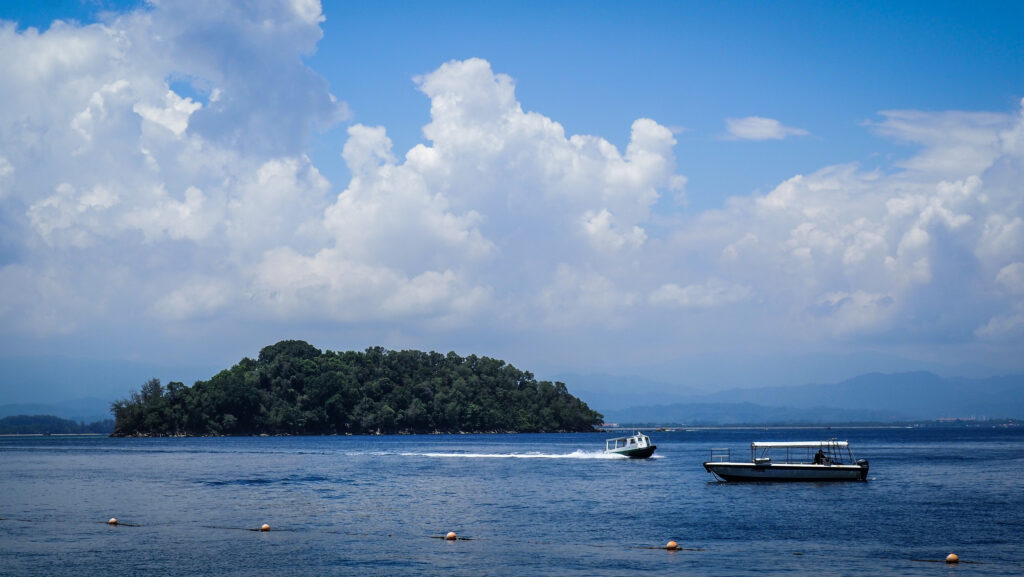
Tunku Abdul Rahman Marine Park

How to get around?

Even though Kota Kinabalu is the biggest town in Sabah state, it’s still quite compact and easy to get around. The city centre can be explored on foot, while more distant places can be easily reached by taxi. Order one by using a popular mobile app – Grab.

What to see in Kota Kinabalu?

Atkinson Clock Tower

It’s the oldest wooden building still standing in Kota Kinabalu that survived the destruction of Jesselton during World War II.

Gaya Street Sunday Market

Gaya Street turns into a night market on Friday and Saturday from 5 PM to midnight and it’s an excellent place to try various local snacks and drinks. On Sunday morning, from 6 AM to 1 PM, it changes into a regular market selling plants, fruits, vegetables, clothing, antiques, etc.

Central Market

Tropical fruits, fresh vegetables, fish as well as seafood can be found here.

Night Food Market

From fresh seafood to traditional Malaysian dishes such as satay or laksa, every stall offers a unique taste experience. The market is usually very crowded and extremely hot, so get yourself ready. Don’t be shy to haggle on the price of seafood, it’s perfectly OK to do so.

Bandaraya Mosque

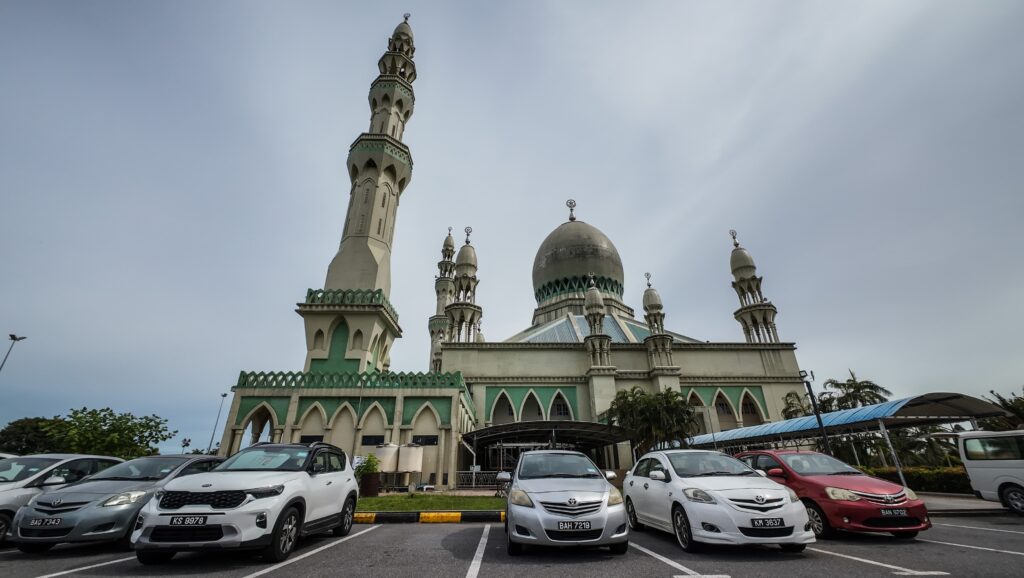
You have to cover up to enter and it’s possible to get clothes at the reception centre. The best is to avoid prayer time as you won’t be allowed inside. There is nothing special to see when it comes to the interior and they charge an entrance fee, which is ridiculous. You can easily take pictures of the mosque from the street outside, catching a nice reflection in the pond. That’s the best thing you can do here!
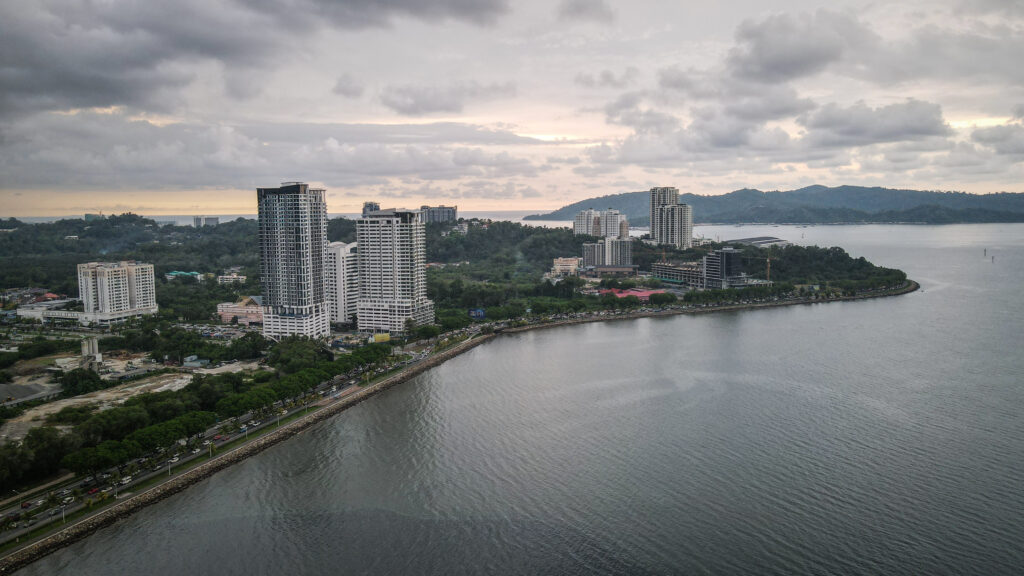
Kota Kinabalu, Borneo
Kota Kinabalu

Taman Awam Teluk Likas

A long stretch of green park and beach along the coastline. Nice place to exercise and relax under the shade enjoying some sea breeze. I wouldn’t swim here though, as the water didn’t look clean.

Sabah State Mosque

The building’s gold accents shine bright and there is some nice greenery around. I wasn’t able to enter the building as it was prayer time.

Sabah State Museum

This museum offers a great introduction to Sabah’s indigenous cultures. Its exhibits include the traditional dress, embroidery, celebrations, rituals, crafts and musical instruments of the Dusun, Murut, Rungus, Bajau and other peoples of Sabah.

The ancient Chinese ceramics discovered in 2013 from the Jade Dragon wreck, which dates back to around AD 1300, are located upstairs. Additionally, the Heritage Village adjacent to the museum features traditional tribal dwellings such as Kadazan bamboo cottages and a Chinese farmhouse.

Sabah Islamic Civilization Museum

The museum presents the history of the spread of Islam in Southeast Asia including the roots of its arrival into Sabah and Malaysia as a whole. It features Islamic artefacts brought from the Middle East countries such as Turkey, Egypt, Iran, Morocco and India as well as local art from Sabah and neighbouring Sarawak and Brunei.

Tanjung Aru Beach

Nice spot to watch sunset with many food stalls nearby. Unfortunately, there is trash all around the place which is hard to ignore. The beach is about 10 – 15 minutes drive from the city centre.

Mari Mari Cultural Village

Mari Mari offers tours that highlight the many traditional residences of the numerous ethnic communities of the Sabahan, including the Bajau, Lundayeh, Murut, Rungus, and Dusun. You will have the opportunity to witness blowpipe construction, tattooing, fire starting, and an understanding of the mystical beliefs of each of these tribes in addition to sampling delicacies from each. Unfortunately, the samples are really microscopic! The visit also includes a buffet meal and a brief dancing performance. Overall, nice but very touristy experience and the guide was sometimes rushing with her explanations.

The morning session starts at 11 AM and the afternoon one at 2 PM. The ticket costs 130 RM for international tourists and 110 RM for Malaysians. You can order a taxi via Grab to get there.

Ulu Kionsom Waterfall

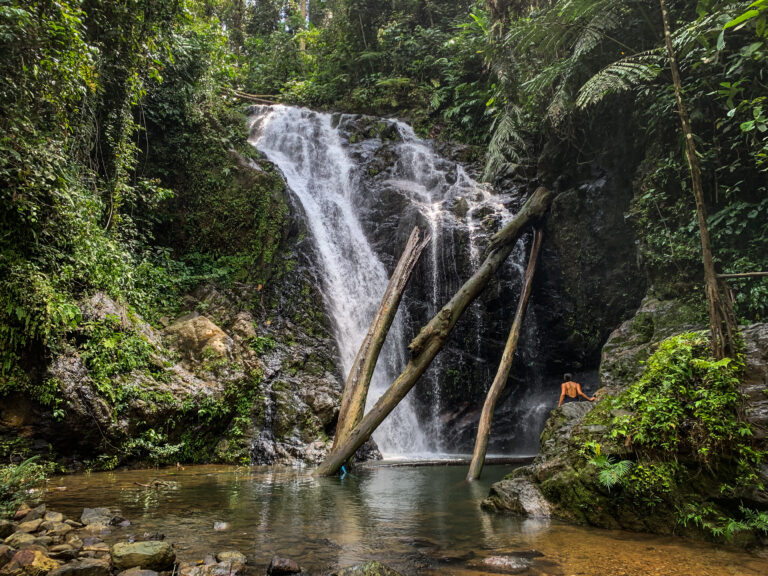
A popular spot for swimming and picnicking among locals, located within walking distance from Mari Mari Cultural Village. After buying a ticket, follow the cemented path with the sound of the rushing water increasing with every step.

To go to the last tier of the waterfall, you have to scramble up the forested slope. The rocks and roots can be very slippery so watch your steps and take a bottle of water.

The ticket costs 10 RM for foreigners and 3 RM for Malaysians.

Monsopiad Heritage Village

A good and less popular alternative to Mari Mari Cultural Village. This traditional village commemorates the life and time of the legendary Kadazan and head-hunter warrior Monsopiad. The schedule is quite typical: presentation of traditional food, medicine, firemaking and hunting techniques followed by music and dance performance. The morning session starts at 11 AM and the afternoon one at 2 PM.

Sabah Art Gallery

The most interesting part is the uniquely shaped building of the gallery. It costs 15 RM to enter for foreigners (compared to 5 RM for locals). The museum itself is extremely small and I was done in 15 minutes. There are some free exhibits outside, so stick to those and save yourself some money for a nice dinner.

Wetland Ramsar Site

A place with lots of potential where among mangroves you can see crabs, monitor lizards and various birds. Unfortunately, the amount of rubbish is overwhelming. The boardwalks are also in dire need of repair so mind your steps.

Puh Toh Si Chinese Temple

A serene and well-kept Chinese temple with a reclining Buddha resting inside. The temple is on a small hill near the highway.

Tunku Abdul Rahman Marine Park

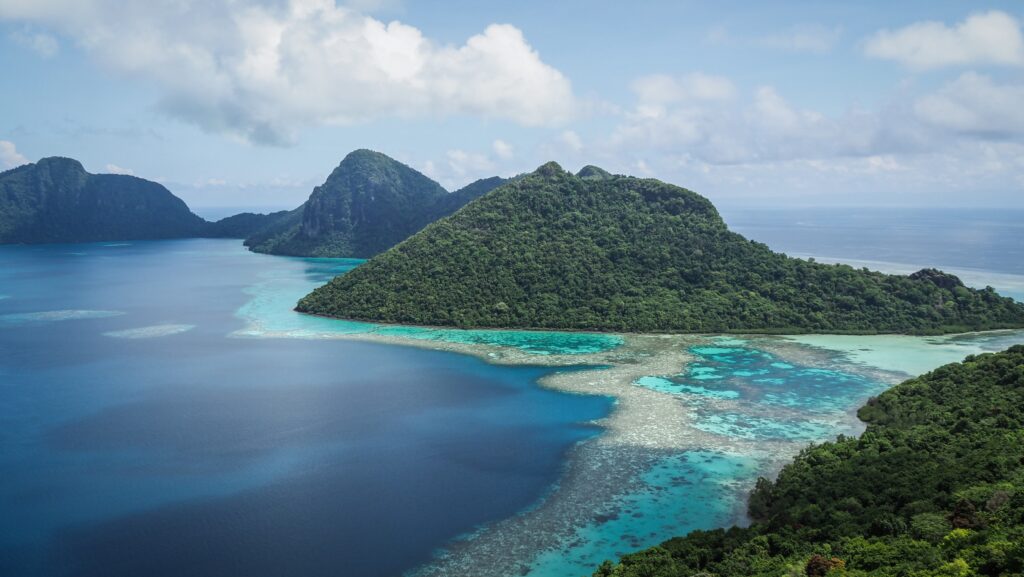
Tunku Abdul Rahman Marine Park is a group of islands and their surrounding waters located off the coast of Kota Kinabalu. The marine park was established in 1974 and is named after Malaysia’s first Prime Minister. The park comprises five main islands: Gaya, Manukan, Mamutik, Sapi and Sulug.

How to get there?

Take a short boat ride from Jesselton Point Ferry Terminal, with services running regularly to the islands. The islands have various facilities, including accommodation options ranging from budget chalets to luxury resorts, as well as restaurants, restrooms, and picnic areas.

As of May 2024, you can visit Mamutik, Manukan and Sapi Islands. Gaya Island is off-limits for day-trippers. You can only go there if you are staying in one of the resorts on the island. There is a large community of illegal migrants from the Philippines which probably has something to do with that.

Boats depart from 8:30 AM and run every 30 minutes. Return time is between 12 PM – 4 PM. Once you reach the island, the tour operator will ask you at what time you would like to be picked up.

tunku abdul rahman marine park
Tunku Abdul Rahman Marine Park

Prices

The price depends on the number of islands that you want to visit.

1 island: 35 RM per person

2 islands: 45 RM per person

3 islands: 55 RM per person

The national park entrance fee (25 RM) and terminal fee (9.20 RM) are added to the price.

Gear rental: fins, life jacket for snorkelling, snorkelling mask or beach mat can be rented for 10 RM each.

A day trip to 3 islands

First, we stopped at Manukan, where I had a walk to the other side of the island to the area called Sunset Point. I was trying to find a hiking trail through the jungle to get there and I did find it, but wearing sandals didn’t prove to be a good idea. Instead, I turned back and followed a concrete path. There were so many mosquitos that it was impossible to stop even for a second!

The sunset point wasn’t anything special and there was a lot of rubbish everywhere On the positive side, it was relatively quiet so I managed to fly a drone and take some aerial photos. Then I walked back to the beach and hung around there waiting for the boat to Mamutik Island.
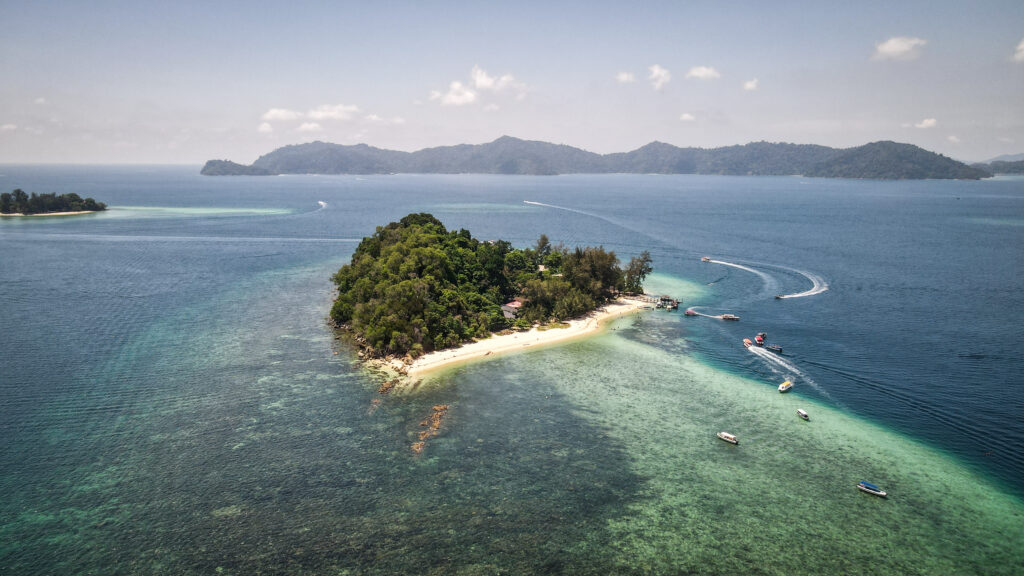
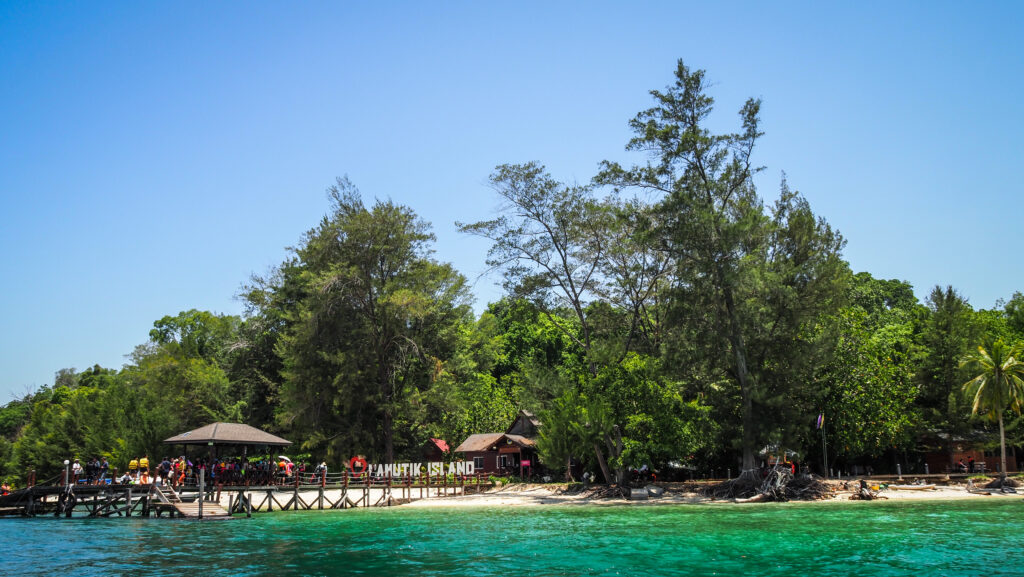
tunku abdul rahman marine park
Tunku Abdul Rahman Marine Park
tunku abdul rahman marine park
Tunku Abdul Rahman Marine Park

Mamutik is the smallest island in the park, with only one resort. I followed a short loop trail and then spent the rest of the time in the shadow of the trees or the warm waters of the South China Sea.

Then it was time for the last stop – Sapi Island, located just next to much bigger Gaya. Tiny place, where I spent most of the time just chilling in the water. Unfortunately, on the next day, I noticed that my legs were full of sandfly bites, so don’t forget the repellent!

Powered by GetYourGuide

Mount Kinabalu is the highest peak in Borneo, standing at 4,095 meters. It is located in the Malaysian state of Sabah and is part of the Kinabalu National Park, which is a UNESCO World Heritage Site.

Mount Kinabalu is a granite massif formed about 10 million years ago. Over time, the mountain has been uplifted, and its distinctive jagged peaks have been sculpted by erosion and glaciation. The mountain is renowned for its rich biodiversity, with distinct vegetation zones ranging from lowland rainforests to alpine meadows. It is home to over 5,000 plant species, including the famous Rafflesia, the world’s largest flower, and numerous endemic orchid species. Kinabalu National Park was established in 1964 and became Malaysia’s first World Heritage Site in 2000.

Mount Kinabalu holds significant cultural and spiritual importance to the indigenous Kadazan-Dusun people, who believe that the mountain is the resting place of their ancestors’ spirits.

The first formal ascent of Mount Kinabalu was recorded in 1851 by Sir Hugh Low, the British colonial secretary on Labuan Island.

On June 5, 2015, an earthquake with a magnitude of 6.0 occurred in Ranau and lasted for 30 seconds. Since the Sabah earthquake in 1976, this was the strongest earthquake to strike Malaysia. There were eighteen confirmed deaths on Mount Kinabalu, comprising six Malaysians, two Chinese, and ten Singaporeans. After becoming stranded on the mountain, about 137 climbers were eventually rescued.

How do you get to Kundasang?

Kundasang is about a 2-hour drive from Kota Kinabalu, the capital of Sabah. You can rent a car at Hikmah Rental & Tours. Excellent contact on WhatsApp and unproblematic rental experience at a good price. The drive offers scenic views of the mountains and countryside.

Shared taxis depart from Merdeka Square in Kota Kinabalu when full. You will pay about 40 RM for a seat and the driver can drop you off at the entrance to Kinabalu National Park.

If you decide to do the hike with a travel agency, transportation by minivan will be included.

Mount Kinabalu, Sabah, Malaysia
Mount Kinabalu

When to go?

The best time to climb Mount Kinabalu is generally during the dry season, which runs from March to September. There is less chance of rain, which makes the trails safer and the views clearer. The summit can be very cold at any time of the year, especially during the early morning hours when climbers aim to reach the peak for sunrise.

Bookings, permits and guides

Let me start by saying that climbing Mount Kinabalu isn’t cheap.

Several operators organize tours to the islands, but the most popular seems to be Borneo Calling. The price of a 2D1N budget hike is 1750 RM for international tourists and 1350 RM for Malaysians. They will organize everything for you: accommodation (Panalaban Hostel or Lemaing Hut), permits and guides.

If you decide to organize your hike independently, you will pay about 1600 RM for accommodation at Laban Rata. On top of that, there is an entrance ticket to Kinabalu National Park (50 RM), a hiking permit (400 RM) and a mountain guide (350 RM). If you arrive at the registration office early enough, you may be lucky to find other people to share the cost of the mountain guide with (max. 5 hikers per 1 guide).

Accommodation at Laban Rata can be booked at the website of Sutera Sanctuary Lodges.

Regardless of the option that you choose, remember that the number of permits is limited and despite the costs, it is a highly popular hike. Therefore, you must book your tour or secure a bed in a hostel a few weeks, or even months in advance.

How long is the hike?

The round trip to the summit of Mount Kinabalu is approximately 17.4 kilometres, typically takes two days and involves two main stages:

Day 1: Trailhead to Laban Rata

Approximately 6 kilometres, 4 to 6 hours with an elevation gain of about 1.400 meters. Hikers usually take a minibus to the Timpohon Gate and start hiking from there, following a well-marked trail through diverse vegetation zones, ranging from tropical rainforest to alpine meadows. The trail is steep and involves many steps. Hikers stay overnight at Laban Rata or one of the other Sutera Lodges Accommodation sites.

Day 2: Laban Rata to summit and back to the trailhead

Approximately 2.7 kilometres to the summit, plus 8.7 kilometres return to the trailhead. It takes between 2 to 4 hours to reach the summit and 4 to 6 hours for the descent. Elevation gain is about 822 meters from Laban Rata to the summit. Hikers usually begin the final ascent around 2 AM to reach the summit for sunrise. The last part of the climb involves steep granite slabs and ropes to assist in the ascent. After reaching the summit, hikers descend back to Laban Rata for breakfast before continuing the descent to the Timpohon Gate.

There is an option to spend an extra night in Laban Rata after the descent from the summit, but it will significantly increase the already high costs of the hike.

There are rest shelters with basic toilets at regular intervals.

Mount Kinabalu, Sabah, Malaysia
Clouds usually roll in after 10 AM

What to pack?

Pack appropriate clothing and gear, including warm layers, waterproof clothing, and sturdy hiking boots. Overall, while the dry season offers the best conditions for climbing, careful planning and preparation can make your climb enjoyable and successful at any time of the year. Here is the list of some essentials:

  • Fleece or insulated jackets
  • Waterproof and windproof jacket and pants.
  • Comfortable and quick-drying pants.
  • T-shirts
  • Warm hat and gloves
  • Socks
  • Hiking Boots
  • Backpack (30-40 litres) with a rain cover.
  • Headlamp
  • Trekking Poles
  • Water Bottle or Hydration Bladder
  • Sunglasses
  • Sunhat and sunscreen
  • Camera or smartphone
  • Climbing permit and ID
  • Cash
  • First aid kit
  • Snacks
  • Insect repellent
  • Towel
  • Optional: power bank (there is an option to charge the devices in Laban Rata)

If you feel that you took too much and there are things you don’t need, leave them in the room at Laban Rata and pick them up on the way back. You don’t want to wear a heavy backpack on the summit push in the night!
Where to stay?

If you go on a hike with a travel agent, they will pick you up in the morning from the hotel in Kota Kinabalu. I based myself there for a few days and can recommend three places: ATAP Hotel, Hotel Tourist by HotSpot Essential and Akinabalu Youth Hostel. All of them were affordable and offered a nice and clean private room.

If you travel to Kundasang independently, I would suggest arriving one day before the hike, to avoid unnecessary rush and morning stress that you won’t make it before 10:30 AM which is the cut-off time to start the hike at Timpohon Gate. I spent the night at Happy Garden, which is a no-frills hostel with a restaurant on-site. It’s within walking distance to the entrance of Kinabalu National Park so you won’t need any further transport in the morning.

Mount Kinabalu, Sabah, Malaysia
Wildlife on the trail 🙂

2D 1N itinerary

Day 1: Timpohon Gate – Laban Rata

I woke up at about 7 AM and had a quick breakfast in the nearby restaurant. Spending the night at Happy Garden meant that I was only 20 20-minute walk away from Kinabalu Park Headquarters.

After arriving at the registration center I quickly succeeded in finding a group of 3 other hikers to share the costs of the guide with. Then, we got our permits, picked up a packed lunch and got ready for departure. The guide was an older man but he spoke quite good English.

To get to the beginning of the trail at Timpohon Gate, we took a minibus. Then, we had a safety briefing and our guide told us that we were a group but if someone wanted to go faster, there was no need to wait for others. Well, fair enough, although in such a case I have no idea why the guide is mandatory at all.

It was exactly as my guide said. Our group soon split and I reached Laban Rata by myself, while the guide simply followed the slower person.

Mount Kinabalu, Sabah, Malaysia
Beginning of the trail
Mount Kinabalu, Sabah, Malaysia
On the trail

Shortly after the beginning of the trail I passed Carson’s Falls and made my way uphill through the beautiful forest. More or less at the halfway to Laban Rata, I made a break for a packed lunch. In the box, there was some fried chicken with veggies. Not particularly delicious but fine enough. The weather was getting worse with more and more fog rolling over the slopes and for a short moment, it was even drizzling. The trail was still forested but soon it changed into a subalpine meadow.

Upon arrival at Laban Rata Resthouse, I got a key to the 4-person dormitory and quickly changed my clothes to the dry set. I didn’t take a shower as the water was freezing cold. Keep that in mind 🙂 After spending some time in the common room, the rest of my group was still not there so I simply took a nap. I felt cold, even though I was wearing my warm puffer jacket from Nepal. Quite strange. Also, even though I felt very tired, I couldn’t fall asleep. It made me a bit worried.

Mount Kinabalu, Sabah, Malaysia
The higher you get, the foggier it becomes
Mount Kinabalu, Sabah, Malaysia
Laban Rata Resthouse

Was it because of the altitude? Laban Rata is located at 3,272 metres above sea level, so some people may experience some discomfort. When the rest of my group finally arrived at the dormitory, it was time to get dinner. The problem was that I had zero appetite and only had some sweet jelly for dessert and drank two cups of tea.

After dinner, I preventively took some pills just to make sure that I would be in good shape in the morning. Unfortunately, I still couldn’t sleep at night.

The meal schedule in Laban Rata is as follows:

Dinner: 4:30 PM until 7 PM

Supper: 2 AM until 3:30 AM

Breakfast: 7:30 AM until 10:30 AM

All the meals are served in the form of a buffet.

Electricity is on from 4 PM to 10 OM and from 1 AM to 3:30 AM.

Day 2: Laban Rata – Summit – Timpohon Gate

The second day started with waking up at 2 AM and having a quick breakfast. I wasn’t too hungry but I had to force myself to eat as I felt I needed some calories. We departed at 2:30 AM. Most of the people left at the same time so there was quite a traffic jam at the stairs. The two women from my group stayed behind already at the very beginning and we waited for a while but there was no sign of them. Later we found out that they had turned back. Did they also experience the same health discomfort as me?

I was going up mostly following the stairs. Then the section with steep granite slabs and the line started. There was no vegetation around. The line was just for assecuration, rather than pulling myself up. I was getting weaker and slower as my body didn’t want to continue that adventure. I was struggling both mentally and physically. I made frequent breaks to catch my breath or even sit down for a while. I think it was a nasty combination of altitude impact as well as stomach issues.

Mount Kinabalu, Sabah, Malaysia
The section with the rope
Mount Kinabalu, Sabah, Malaysia
The section with the rope

I was fighting my way up while the sunrise was getting closer and closer. I could already see the summit but still, it looked quite far away. The last section was really steep and involved some easy scrambling on the rocks.

Finally, I reached the top! The other guy from my group arrived shortly after me. Then, even our guide showed up! We took some pictures with the board showing the name of the mountain and started the descent. It was the last time when I saw the two guys from my group. The way down was certainly much easier and I started taking off layers of my clothes as the sun was quickly warming me up. While looking back, I was impressed that I climbed up all that way in the darkness.
Mount Kinabalu, Sabah, Malaysia
Sunrise at Mount Kinabalu

After reaching Laban Rata, I had a small breakfast with French toast and some fried potatoes. I also met the two women from my group and they confirmed that they turned back as one of them didn’t feel good. I think they expected a way easier adventure climb, the same as me. But Mount Kinabalu isn’t that easy after all!

The remaining distance down to Timpohon Gate was a real pain in the *ss. My knees were done as the total elevation drop was over 2.000 meters! Adding to that, the path was steep and full of rocks and stones. With two breaks en route, I finally made it to the Timpohon Gate and I bought a coke and mineral water there. A minibus was waiting to take hikers back to the Kinabalu Park Headquarters but the driver said we needed to wait for more people to join. We had been waiting for about half an hour and the group of 4 hikers arrived. Once we were on the way to the parking, heavy rain started. What a timing!

Mount Kinabalu, Sabah, Malaysia
Descending from Mount Kinabalu

At the Kinabalu Park Headquarters, I asked about transport options back to KK but they could only offer a private shuttle for 250 RM. It was way too much! I waited a bit for the rain to stop and then walked towards the roadside to try to flag down some minibus. I had been waiting for about 15 minutes when I noticed the first minibus heading in my direction. It was full but shortly after another stopped and then I jumped on board.

Alternative descent: Via Ferrata

Once booked a tour, you can also opt for the itinerary including via ferrata on the descent. Situated on the Panalaban rock face of Mount Kinabalu, Mountain Torq is the highest via ferrata in the world and the first via ferrata in Asia.

Walk the Torq and Low’s Peak Circuit are the two Via Ferrata itineraries that are offered. Climbers with no prior professional mountaineering experience can enjoy the activity on both routes.

Was it worth it?

All in all, it is a great, scenic and challenging hike. But is it worth the price? In my opinion, it isn’t. Before arriving in Borneo, I spent one month in Nepal. The amount of money that I paid for the 2D1N hike to the Kinabalu summit would probably keep me going for over a week or even more in the Himalayas, with definitely much more spectacular views. There are no alternatives to Sutera Sanctuary Lodges which use their monopoly to charge excessively for literally everything, but the quality is just average.

What else to do around Kundasang?

Kinabalu National Park

There are several shorter trails in the park that you can combine into one loop and hike without a guide. From the main entrance, join the Liwagu Trail and then turn left onto Mempening Trail. Follow it until you reach an asphalt road. Then, to come back to the main entrance, join Kiau View Trail or Silau Silau Trail. Kiau Gap View Point is an excellent place in clear weather, so arrive here very early in the morning.

As of May 2024, Liwagu Trail was closed after the crossroad with Mempening Trail.

There is also the mountain garden which is open from 9 AM to 4 PM every day. Visitors can visit the garden and roam by themself at any time during the opening hours, however, guided tours with Sabah Park’s interpretation guide are scheduled at 9 AM, 12 PM and 3 PM.

Aki Aki Trail

The 3.3 km trail with proper facilities such as staircases and platforms with a view of the majestic Mount Kinabalu. However, it goes through private property and you need to hire a guide. I have seen some reports from people saying that they were quoted over 200 RM, which is totally ridiculous and sounds like a scam.

Kundasang War Memorial

It honours the British and Australian detainees who lost their lives during the infamous Sandakan Death Marches and at the Sandakan and Ranau POW camps as well as Borneo natives who lost their lives helping them.

Quite a pity that even in a place like this, there is a double pricing for Malaysians and foreigners.

Maragang Hill

The Maragang Hill, which is 2,232 metres above sea level, was opened to the public in 2017. Hikers can choose from different packages, such as sunrise hikes (3 AM) and regular hikes (6 AM) on the conventional or loop trail. The regular trail takes roughly 3-4 hours to finish on average. I opted for a regular 6 AM version and arrived on time at the meeting point. The guide was late for about 20 minutes and I was slowly getting annoyed because I was aware that shortly after sunrise, Mount Kinabalu could be covered in clouds. Finally, when the guide arrived, we jumped inside a pick-up truck and were taken higher up the road to the trailhead. Having a guide on this trail was ridiculous as it was very easy to follow and the guy was simply walking behind me smoking cigarettes all the way.

After about an hour or so we arrived at the top and the views were great. Mount Kinabalu from that perspective looked simply breathtaking. I flew a drone around and took some nice aerial pictures before we started our descent. I was pretty much overtaking all locals on the trail as they were walking so damn slowly.

The guide can be booked via WhatsApp. Phone numbers are available on the website HERE. As of May 2024, the price is 155 RM if you are going solo.

Kinabalu, Sabah, Borneo
Maragang Hill
Kinabalu, Sabah, Borneo
The view from Maragang Hill

Sosodikon Hill

Good and both cheaper and easier alternative to Maragang Hill. The entrance ticket costs 10 RM per person for foreigners. It is a very short 1 km return trail with spectacular views of Mount Kinabalu on a clear day. Come early in the morning!

Kinabalu, Sabah, Borneo
Aerial view os Sosodikon Hill

Last POW Camp Memorial

The Japanese occupiers of Sabah in 1945 forced 641 British and 1793 Australian prisoners of war to march from Sandakan to Ranau. Only six people made it out alive by hiding and getting looked after by locals. The rest died as a result of disease, arduous labour, unfavourable living conditions, or were slain by their captors. The 183 men who perished at this final camp, which was located next to a bend in the Kagibangan River that can be seen below, are listed on the memorial stone. The place is located 6 km away from Ranau.

Poring Hot Spring

The site is made up of about a dozen little pools that are heated by sulfurous water that emerges from an underground spring. The best thing that adventurous people can do here is the hike to Langanan Waterfall, which takes about 2 hours one way. Make sure that you start the hike before noon, as later the entry isn’t allowed.

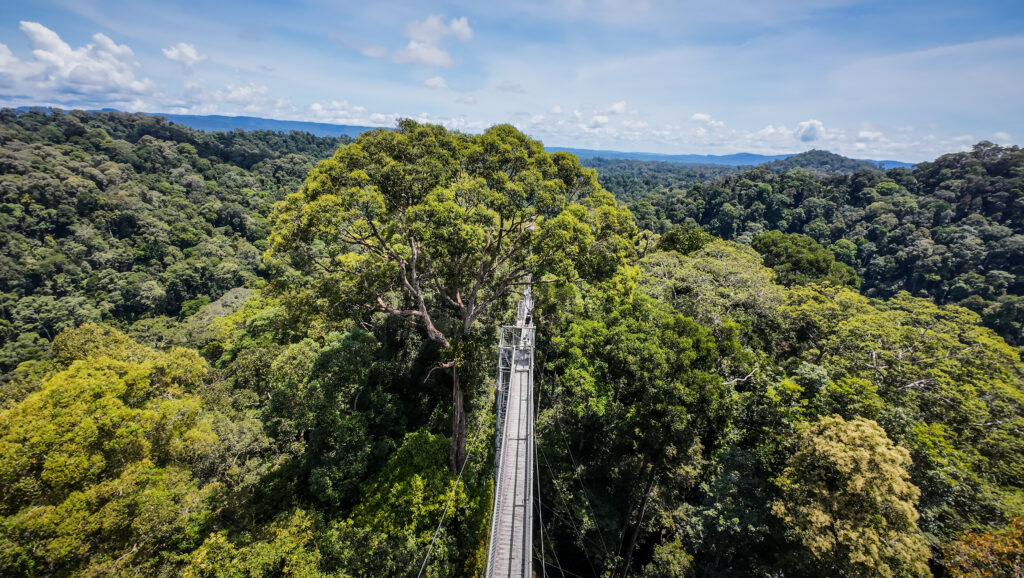
Another nice activity is climbing up to the canopy walkway, suspended from trees and reaching up to 40 meters above the jungle floor, offering breathtaking views of the surrounding forest.

There is also a butterfly and orchid garden. The problem is that the ticket price to the park is quite steep: 50 RM for foreigners and then you need to pay extra for each activity inside, such as hot springs or canopy walkway (10 RM). The business model of a tourist trap!

Mahua Waterfall

The waterfall is located about 500 meters from the entrance. The water is cold and clear. The entry costs 20 RM for adult foreigners and RM12 for children. There is a BBQ area, tables and chairs. It’s about 1-hour drive following route 500 from Ranau.

Powered by GetYourGuide

Semporna is a district located on the east coast of Sabah, Malaysia. It is renowned for its stunning marine biodiversity and is a gateway to several of the world’s best diving sites, such as the famous Sipadan Island. The region attracts divers and tourists from around the globe due to its crystal-clear waters, diverse coral reefs, and rich marine life, including sea turtles, sharks, and various tropical fish species.

In addition to diving, Semporna offers activities such as island hopping, snorkelling, and exploring the local markets and seafood restaurants. The town of Semporna itself provides basic amenities and serves as a hub for tourists heading to nearby islands and marine parks.

Semporna is also culturally rich, with a significant population of the Bajau people, known as sea gipsies, who traditionally live a nomadic lifestyle on the sea. The Bajau Laut are known for their unique maritime skills and stilted houses built over water.

How to get to Semporna?

By Air

Several airlines operate flights to Tawau Airport (TAW), including Malaysia Airlines and AirAsia, with direct flights available from Kota Kinabalu (the capital of Sabah) and Kuala Lumpur (the capital of Malaysia). From Tawau, take a minibus going to Semporna. The drive takes about 1.5 – 2 hours.

By Land

There are bus services from Kota Kinabalu to Semporna but be prepared for a very long journey (most probably over 10 hours).

For ticket booking, visit Easybook or 12Go.Asia

Powered by 12Go system

By Ferry

Some ferries connect Tawau with Nunukan and Tarakan in Indonesian Borneo. The ferry services are less frequent, so checking the schedule in advance is important. From Tawau, take a minibus going to Semporna. The drive takes about 1.5 – 2 hours.

Semporna, Sabah, Borneo
Snorkelling in Semporna

When to go?

The best time to visit the Semporna is during the dry season, which typically falls between March and October. The weather during these months is generally more favourable with less rainfall, making it easier to explore the islands (the sea is calm) and enjoy outdoor activities.

Where to stay?

I can recommend staying at Warisan Family Inn or Kuree Hut. Both are well-located, in the town centre with plenty of restaurants and shops. They can also help you to organize trips to the islands. Warisan Family Inn is closer to the waterfront if that matters. The rooms were clean and spacious!

How long should you stay?

Semporna doesn’t have much to offer but you can easily spend a few days visiting nearby islands, so it depends on your preferences. I spent one day in town and three days doing island hopping but some people prefer going just to one island and staying longer there, diving or just chilling at the beach.

Semporna, Sabah, Borneo, Malaysia
Snorkeling at Sibuan Island

What to do in Semporna?

Bukit Tengkorak Archaeological Site

Situated on a slope approximately 600 feet above sea level is this archaeological site. Bukit Tengkorak is a volcanic rock-shelter site and a part of a volcano mouth of 2km in diameter. The location housed Southeast Asia’s greatest ceramic production during the Neolithic era. In the small museum at the foot of the steps, one can learn more details about the discovery of this archaeological site. It’s free to visit.

You will have to climb quite a lot of wooden steps to get on top but it’s worth it. A beautiful panorama of the Semporna area can be admired from there. The best way to reach Bukit Tengkorak Archaeological Site is to use the mobile taxi application: Grab.

Semporna, Sabah, Borneo
The view from Bukit Tengkorak Archaeological Site
Semporna, Sabah, Borneo
The view from Bukit Tengkorak Archaeological Site

Museum Tun Sakaran

Exhibits about Tun Sakaran, who was  Sabah Governor or Head of State, and his role as a community leader can be seen on the museum’s ground floor. On the first floor, there are displays on the history and culture of Semporna and the surrounding area. It’s free to visit.

1-day trips to the islands

The islands are the main Semporna’s appeal as a premier marine tourism destination, offering a range of activities from diving to serene beach vacation. Some people head there directly, without even stopping at the town itself.

Most of the islands can be visited on a one-day trip, which is a great option for those travelling on a budget. You can also arrange longer stays in the resorts, but that will cost you significantly more.

Unfortunately, out of the three tours that I did, only one was organized 100% in line with what was advertised. Some operators insist on skipping certain locations once you are already on the sea, or they just pass by the island without landing on it. Make sure your tour operator has plenty of good reviews!

Powered by GetYourGuide

Mabul and Kapalai Islands

I was picked up from the hotel in the morning and delivered by car to Pelancong Jetty. The rest of the group was already waiting, so we set off to Mabul Island immediately. We passed by huge Bum Bum Island and soon got a glimpse of our first destination on the horizon. The rest of my group was there for diving, so the boat dropped me and one of the guides off at Mabul Island, and then they left for their dive spot.

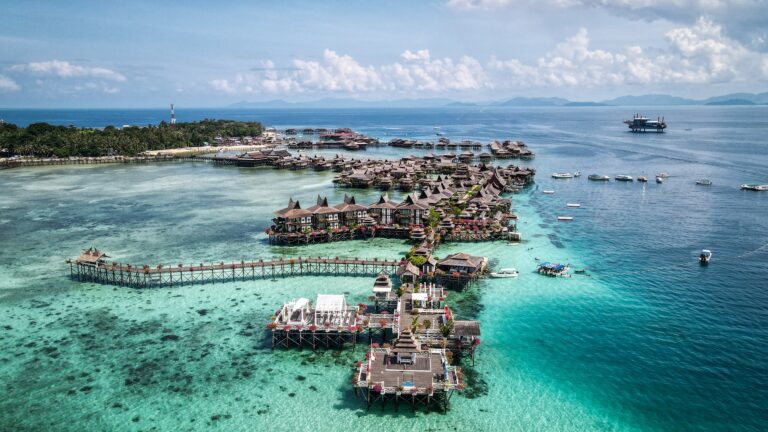
The fee to enter the resort area at Mabul Water Bungalows is 50 RM per person, which is way too much, as you only get access to boardwalks and photo spots. At least I found a nice place in the shade to fly a drone. There were lots of sea gipsies on the small boats selling coconuts.

Semporna, Sabah, Borneo, Malaysia
Sea gypsies
Semporna, Sabah, Borneo, Malaysia
Mabul Island

We left the territory of the resort and went to the other side of the island, passing through the section where the staff working in the resort must live. The guide recommended another nice spot for flying a drone, in the middle of palm trees. It was quite nice indeed!

Soon, we stepped into a normal village where the local population of the island lives, and it was a much more interesting and authentic place to see than the resort filled with Chinese tourists. When we reached the pier, the rest of my group was already waiting there, and we had lunch together.

After lunch, it was time for the first snorkelling session near Kapalai Island. It was nice, and we could see plenty of fish and even some huge turtles, but unfortunately, swimming around and freediving was hard as fins weren’t provided. We didn’t land on the island, as essentially it’s just a sandbar with a resort built on stilts.

Semporna, Sabah, Borneo, Malaysia
Mabul Island
Semporna, Sabah, Borneo, Malaysia
Mabul Island

Then, we went back to Mabul Island for a second snorkelling session. That one was quite disappointing as the water wasn’t clear, and instead of a natural reef, there were just some submerged artificial structures.

We arrived back at Semporna at about 4 PM. Overall, it was a nice trip. Compared to the ones described below, the food was the best, but the underwater world was the least memorable.

The trip cost 150 RM per person, and it was arranged for me by the Kuree Hut where I was staying. Lunch, water and snorkelling equipment (without fins) were provided.

Mataking and Timba Timba Islands

I checked in at Semporna Jetty at 8:30 AM and was welcomed by the staff. Besides me, all the other tourists on the boat were divers. There were 3 snorkelling sessions: 2 at Mataking Island and 1 at Timba Timba Island. All the places were amazing and it was surely one of the best, if not the best, snorkelling that I experienced in Southeast Asia. The equipment was of superb quality, and fins were included. I saw a lot of colorful fish but the highlight was huge green turtles coming up from the depths. Wow!

Semporna, Sabah, Borneo
Turtle seen at Timba Timba Island
Semporna, Sabah, Borneo
Snorkeling at Timba Timba Island

The trip cost 180 RM per person and I arranged it with Seabunny. The snorkelling equipment was in excellent condition (fins included), and the staff was really friendly. However, we weren’t able to set foot on any of the islands and the whole day was spent on the boat only. It was a big disappointment, considering how beautiful the sandbank at Timba Tima Island is. The staff explained that it’s because both islands are private properties, however, I found info online that it’s possible to visit, but you simply need to pay extra. It would be nice to be offered a choice!

Boheydulang, Sibuan and Mantabuan Islands

I was picked up from the hotel in the morning and delivered by car to Pelancong Jetty. The first stop of the day was at Boheydulang Island, where we did a sweaty 20-to 30-minute hike up to the viewpoint. Every few meters there is a ‘guide’ monitoring if everyone is fine, as the place is very popular. The view was really worth the effort, even though I ended up completely soaked in sweat. Don’t forget water!

Semporna, Sabah, Borneo, Malaysia
The view from Boheydulang Island

From there, we were supposed to go to Mantabuan Island but the boat crew was doing everything to discourage us from that. Unfortunately, they wanted to skip it and come back earlier to Semporna, which was absolutely not fair. Luckily, most of the participants protested, so we ended up going there. We didn’t land on the island but the offshore snorkelling was superb with plenty of starfish around!

Semporna, Sabah, Borneo, Malaysia
The view of Mantabuan Island

Next, we stopped at Sibuan Island, where we had our lunch and some free time to walk around the sandbank. Unfortunately, drone flying wasn’t possible as all the islands are part of Tun Sakaran Marine Park, plus there is a Military Zone.

Semporna, Sabah, Borneo, Malaysia
The sandbank at Sibuan Island

Soon, it was time for another snorkeling session, and we boarded the boat only to be dropped off… at another side of Sibuan Island, a few meters from the beach. Hillarious! Basically, we could have just walked there… Snorkeling there was really mediocre, and it was a pretty clear sign that the boat crew wanted to finish the tour as soon as possible.

Overall, we all came back to Semporna with mixed feelings. The beauty of the islands is unquestionable, however, the behaviour of the tour operator was really bad and disrespectful. The trip cost 250 RM per person, and it was arranged for me by the Kuree Hut where I was staying. Lunch, water and snorkelling equipment (without fins) were provided.

Semporna, Sabah, Borneo, Malaysia
Snorkelling at Mantabuan Island

Sipadan Island

The 600-meter vertical drop around the island is covered in coral with much variety and quantity of marine life. A typical day at Sipadan includes seeing numerous enormous green and hawksbill turtles, herds of hundreds of enormous bumphead parrot fish, schools of thousands of jackfish, and enormous schools of barracuda.

There are limited permits shared by tour operators each day, and larger resorts get more permits. Each permit allows a diver to dive for a day at Sipadan Island. Try to book your trip and permit as early as possible, especially during peak season, to avoid disappointment.

Bum Bum Island

It is situated about one kilometre east of Semporna town and is separated from the mainland by a Tando Bulong Channel. There are several floating, homestay-style options for accommodation and snorkelling and diving are offered. To get there, you can easily find a boat at the public jetty in Semporna.

Semporna, Sabah, Borneo
Bum Bum Island seen from Semporna

The Tip of Borneo, known locally as Tanjung Simpang Mengayau, is a prominent landmark located in the northernmost part of Borneo Island, within the Malaysian state of Sabah. Local villages are populated by the Rungus ethnic tribe, where traditional lifestyles and skillfully made handicrafts can be seen. They are also particularly notable for their traditional longhouses.

The Kudat Peninsula is definitely worth a visit for those who like nature without crowds!

How to get to the Tip of Borneo?

There is no public transport around the Kudat Peninsula, so renting a car from Kota Kinabalu and making a trip there independently seems to be the best option. I haven’t seen any car rental companies with good reviews in Kudat.

Alternatively, base yourself in Kudat and arrange transportation there from your hotel. Most likely they will help you to find a taxi driver or you can try your luck and look for one in a popular ride-hailing app Grab.

When to go?

The Tip of Borneo can be visited the whole year, but the best time to visit is between February and April, during the dry season. The weather during these months is generally more favourable with less rainfall, making it easier to enjoy outdoor activities, especially in the afternoons.

The Tip of Borneo, Sabah
The beach at the Tip of Borneo

How long should you stay?

Keeping in mind the distance from Kota Kinabalu (nearly 200 km), at least two days are needed to travel comfortably and have enough time to relax on the beach, visit the tip of the peninsula and drop by to Kudat.

Where to stay?

There are a lot of nice accommodation options near the tip, such as Tampat Do Aman which includes walking trails, a watchtower for looking out over the dense forest and a small museum dedicated to the Rungus people. You can also camp near Kelambu Beach which must be an amazing experience while enjoying starry nights.

In Kudat, I recommend staying at The Upper Deck Hotel. Basic, but very clean and spacious room, well located in the centre of the town.

The Tip of Borneo, Sabah
Kalampunian Lighthouse

Places worth seeing

The Tip of Borneo

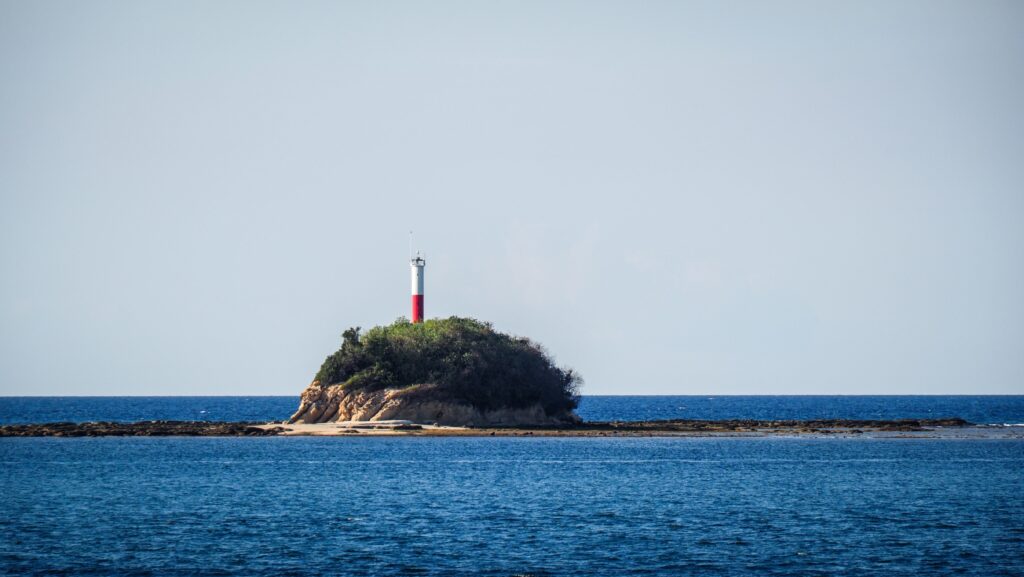
Situated in the Kudat Peninsula, it is where the South China Sea meets the Sulu Sea, offering stunning panoramic views of both bodies of water. A large bronze globe monument marks the place, symbolizing its geographical significance. It’s a beautiful place to enjoy the sunset and you can spot Kalampunian Lighthouse in the distance.

The Tip of Borneo, Sabah
The aerial view of the Tip of Borneo
The Tip of Borneo, Sabah
Globe monument
The Tip of Borneo, Sabah
The place where South China Sea meets Sulu Sea

Kalampunian Beach

This beach is truly a gem, offering a serene atmosphere. The fine, white sand is a delight to walk on, perfectly matching with turquoise water.

Kelambu Beach

Another beautiful sandy beach. At low tide, you can walk to the small island across. Be wary not to get stranded when the tide comes in. The only drawback is the rubbish being washed up during high tide. There are nice campsites on the other side of the road, but don’t expect a mobile signal (which may be an advantage).

The Tip of Borneo, Sabah
The aerial view of Kelambu Beach

Kudat

Kudat has historical importance as it was one of the early settlements of the British North Borneo Company in the 19th century. The town was officially established in 1881. You can kill some time here strolling or jogging along the sea at Kudat Park or visiting the Tun Mustapha Museum or Fuk Tek Kung Temple.

Tun Mustapha Museum is the first museum built in Kudat which aims to showcase the life story of Tun Mustapha (the first governor of Sabah) as well as the culture and history found in the Kudat district.

Fuk Tek Kung Temple is one of the few Taoism temples in Sabah. It was built in the early 1970s by the nearby Hokkien Association.

Bak Bak Beach is the nearest recreational spot near the city although it can be quite windy. There are a few stalls selling food.

Banggi Island

The island is well off the beaten track, with limited infrastructure and basic amenities, available in larger settlements like Karakit. It lies within the South China Sea and is close to the southern Philippines. The beaches on the island are littered with rubbish, and there isn’t much to do. On the other hand, you can bargain with fishermen to take you to nearby Maliangin Island, a little island with picture-perfect beaches, lush tropical vegetation, and crystal-clear water. Balambangan Island is a more distant and more expensive to get to but would be another nice idea for a day trip.

To get there, you will need to take a boat from the town of Kudat. The boat ride takes an hour or two, depending on the sea conditions.

Powered by GetYourGuide

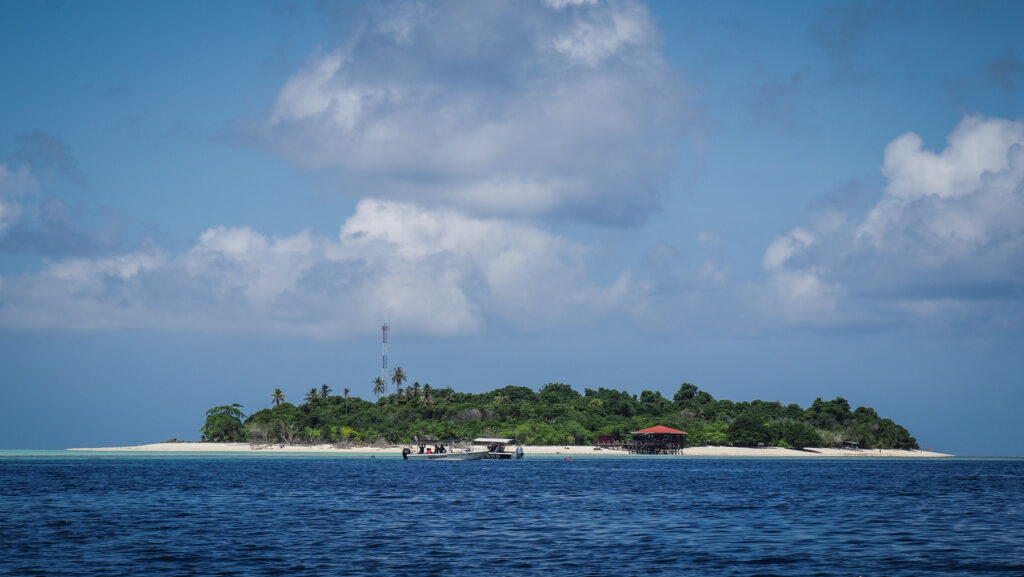
The three remote islands known as the Mantanani Islands are situated northwest of Kota Belud, a town roughly an hour and a half drive from Kota Kinabalu, the state capital of Sabah. Depending on the state of the sea, the speedboat voyage from the mainland to these islands takes about 60 minutes. The islands are a great place to go snorkelling, scuba diving, or island hopping because of their beautiful, white sand beaches surrounded by coconut palm trees, and their clear, blue waters that are home to a variety of marine life. The unique dugong, or sea cow, lives in the water there but sightings are not guaranteed as these mammals are very shy and will distance themselves, especially with the sight of crowds.

How to get to Mantanani Island?

The transfer to the island is included in the package for the day trip. If you decide to stay there longer than a day, your resort will organize a transfer for you as well.

The transfer includes the bus or minivan from your hotel in Kota Kinabalu to Kota Belud Jetty and then a speedboat further to Mentanani Island.

Several operators organize tours to the islands. I chose the offer of Borneo Calling as the price was attractive: 260 RM. Amazing Borneo is a bit more expensive and the tour costs about 340 RM. I didn’t see any differences in the itinerary.

When to go?

Tours to Mantanani Island are available the whole year, but the best time to visit is between February and April, during the dry season. The weather during these months is generally more favourable with less rainfall, making it easier to enjoy outdoor activities.

How long should you stay?

One day is enough to relax on the beach and do some snorkelling. However, during the day it is incredibly hot so most probably you will want to spend the time in the shade. Staying overnight is a great idea, as you can enjoy the magnificent sunset and sunrise and the calmness of the island once day trippers leave.

Mantanani Island, Borneo
Mantanani Island

Where to stay?

I haven’t spent the night on the island itself, but based myself in Kota Kinabalu and did a day trip from there. I can recommend three places to stay there: ATAP Hotel, Hotel Tourist by HotSpot Essential and Akinabalu Youth Hostel. All of them were affordable and offered a nice and clean private room.

How to get around?

The island is small so you will need nothing else but your legs!

A day trip itinerary

I was met by a minibus driver punctually at 7:30 AM and then we made a loop around the town, picking up a few more tourists. The drive to the jetty in the Kota Belud district took approximately 1.5 hours with a short toilet break halfway. The further speedboat ride took about 60 minutes. The sea conditions were good so it wasn’t too bumpy.

Once we arrived at the island, we were taken to Lovely Mantanani Beach Club. We left our bags there, had a drink and went back to the speedboat to start our snorkelling adventure. The two spots were fine and we could see some colourful fish but definitely, it wasn’t as good as it was in Semporna.

The lunch was served at around 12:30 PM. The food was tasty and plentiful, even though I expected a buffet. After lunch, we were free to take a walk on the white sandy beach, enjoy the kayaks or simply relax in the shade. I used the opportunity to fly a drone, after previously asking the guide if it was allowed as I noticed a small police station nearby.

We departed back to Kota Belud Jetty at around 3 PM. There were dark clouds on the horizon and I was sure we would be caught by heavy rain. Miraculously, we weren’t. But as soon as we changed to the minivan and started driving back to Kota Kinabalu, the heavens got wild and it was pouring almost the whole way. I was back to my hotel at about 6 PM.

Overall, it was a well-organized tour of the beautiful island, but next time I would consider staying overnight to get the full experience. Waking up in such isolated places is always unique.

Included in the tour package are: transportation, lunch, water, and snorkeling equipment.

Powered by GetYourGuide

Sandakan was once the capital of British North Borneo (now Sabah) before the capital was moved to Jesselton (now Kota Kinabalu). It played a significant role during the British colonial period and World War II.

It is known for the Sandakan Death Marches, one of Asia’s most tragic World War II events. Many Australian and British prisoners of war were forced by the Japanese to march under brutal conditions, leading to the deaths of almost all involved.

Sandakan is a gateway to several natural attractions. It is close to the Sepilok Orangutan Rehabilitation Centre, which attracts many visitors interested in wildlife conservation. Other notable sites include the Rainforest Discovery Centre, Turtle Islands Park, and the Gomantong Caves, famous for edible bird nests.

How to get to Sandakan?

By Air

Several airlines operate flights to Sandakan, including Malaysia Airlines and AirAsia, with direct flights available from Kota Kinabalu (the capital of Sabah) and Kuala Lumpur (the capital of Malaysia). The best way to get from Sandakan Airport to the city centre is to use the ride-hailing service, Grab.

By Land

There are bus services from Kota Kinabalu to Sandakan passing through Kundasang and Sepilok. The journey takes about 6-8 hours.

For ticket booking, visit Easybook or 12Go.Asia

Berhala Island
Berhala Island

When to go?

The best time to visit Sandakan is during the dry season, which typically falls between March and October. The weather during these months is generally more favourable with less rainfall, making it easier to explore the rainforest (the trails are less muddy) and enjoy outdoor activities.

How long to stay?

Sandakan itself can be easily discovered in one day. If you are planning to visit natural attractions around Sepilok or Turtle Islands Park, you should plan 2-3 days more.

Where to stay?

I spent two nights in AeCOTEL and would recommend this hotel. The rooms were spacious, everything was very clean and the beds were comfy. They also have scooters for rent and can help you to book a river cruise at Kinabatangan.

How to get around?

You can comfortably get around using the ride-hailing app – Grab. If you want to be more independent, a good idea is to rent a scooter. I rented one at my accommodation: AeCOTEL.

What to do in Sandakan?

Agnes Keith House

A restored colonial mansion called Newlands, presents the story of American writer Agnes Keith and her British husband Harry, the Conservator of Forests in North Borneo. They spent three years in Japanese internment camps during World War II and resided in Sandakan from 1934 until 1952. Keith immortalized the house in her hilarious, engrossing, and award-winning depiction of colonial life in Land Below the Wind.

Sandakan, Sabah, Borneo, Malaysia
Agnes Keith House

Sandakan Old Chinese Cemetery

The Chinese Cemetery is spread over the hillside and is quite impressive, especially if you have not seen a similar place previously. It is still used as some of the graves are recent but some parts are overgrown. You can walk through most of it using the steps and pathways.

Berhala Island

An island with a truly local and authentic village. You won’t find any resorts there. The village is not big and it takes about half an hour to visit. Unfortunately, I felt completely overwhelmed with the amount of rubbish, especially plastic bottles that I saw all around.

You can also hike up towards Berhala Island Lighthouse but the trail isn’t easy to find so you will need to ask locals for directions or hire a guide.

To get there, look for a boat at the pier behind the fish market at Sandakan Central Market.

Sandakan, Sabah, Borneo, Malaysia
Berhala Island
Sandakan, Sabah, Borneo, Malaysia
Berhala Island
Sandakan, Sabah, Borneo, Malaysia
Berhala Island

Sandakan Central Market

All seafood, veggies and fruits are fresh and sold at an affordable price here. Very clean place for both dry and wet markets. The surroundings of the market are very lively. Right outside, you can see the waterfront, harbour mall and lots of shops and restaurants.

Sim Sim Water Village

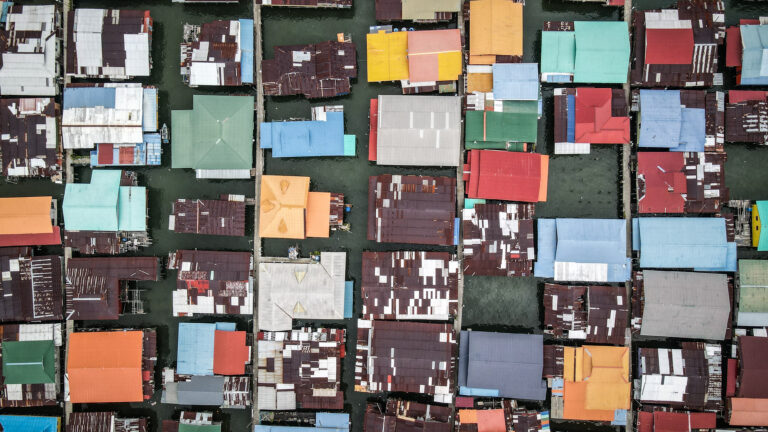
A charming and unique village that is known for its traditional stilt houses and picturesque waterfront views. Known as one of the oldest and most historic water villages in Sabah, Sim Sim can be explored on foot. It’s a must-visit in Sandakan, for anyone interested in admiring the traditional architecture of the stilt houses and sampling delicious local cuisine from the waterfront eateries. I got rice with dried fish and sambal for as little as 1 RM!

Sandakan, Sabah, Borneo, Malaysia
Sim Sim Water Village

Trig Hill

A great place to admire the panorama of Sandakan. Unfortunately, the Rotary Tower was closed and I couldn’t climb it.

Puu Jih Syh Temple

One of the finest Chinese temples in Sabah. It’s about 4km west of the city centre centre and provides beautiful panoramic views from its terrace.

St. Michael’s and All Angels Church

This Anglican church, a relic of colonial times and a monument to Christian worship, is the first and oldest stone church in the State of Sabah, completed in 1925.

Sandakan Memorial Park

The location marked by a stunning rainforest garden was a Japanese prisoner of war camp and the beginning of the infamous WWII “death marches” to Ranau. By July 1945, only six Australian escapees remained alive out of the 1793 Australians and 641 British servicemen who had been imprisoned here in the beginning. The only tangible remnants are a concrete water tank and a few rusty machinery from the British agricultural station that was converted into a jail.

Check the offer of guided treks, following the route of death marches.

Astana Height Recreation Park 

A very pleasant and interesting loop trail. Breathtaking views from the top toward Berhala Island and Sim Sim Water Village. Be careful on the stairs as they might be a bit shaky.

Sandakan Rainforest Park

Beautiful scenery of nature and you can hear different types of birds singing. There are wide, concrete paths, often used by locals for jogging. If you want to be more adventurous, take a turn into a proper jungle trail. It was surprisingly wild and quite difficult loop with many ups and downs. No fees are required to enter the park.

What to outside of Sandakan?

Sepilok

The place is renowned primarily for the Orangutan Rehabilitation Centre, Bornean Sun Bear Conservation Centre, and hiking opportunities at the Rainforest Discovery Centre. Read more in a separate post HERE.

Sepilok, Sabah, Borneo
Bornean Sun Bear Conservation Centre

Turtle Islands Park

40 kilometres to the north of Sandakan is the Turtle Islands Park including three small islands: Selingan, Gulisan, and Bakungan Kechil. It encompasses the nearby reefs and oceans and spans 1,740 hectares. This park is unique since it is home to two different types of turtles: green and hawksbill. They come ashore at night to lay their eggs all year round. Every one of the three islands has hatcheries. The islands offer more attractions than only sea turtles. The crystal-clear, turquoise-coloured ocean and its surrounding coral reefs are perfect for diving, snorkelling, and swimming.

It takes you about 45 minutes by boat from Sandakan to the island. With no day trips allowed at Turtle Island, this overnight package is the shortest option to witness the magic of baby turtles hatching off the coast of Sandakan. Similar to other activities including nature in Sabah, it isn’t cheap and you should expect to pay about 1500 RM per person for the 2D1N package.

Gomantong Caves

It’s a stinky and dirty place but if you are not afraid of cockroaches then this cave is worth going to. You might get lucky and witness how locals collect edible nest swiftlet plus don’t forget to keep your head up as orangutans are hanging around high in the trees from time to time.

For most of the tourists coming here, Gomantong Caves is included in their Kinabatangan River Cruise package. If you are not on tour, you will need to rent a car to reach it.

Powered by GetYourGuide

Tawau is situated on the southeast coast of Sabah, bordered by the Celebes Sea. It is close to the borders with Indonesia’s Kalimantan region and the Philippines.

The area was originally inhabited by indigenous groups and later became a part of the Sultanate of Sulu. In the late 19th and early 20th centuries, Tawau came under British control as part of North Borneo. It developed as a trading port, exporting agricultural products like rubber and tobacco.

During World War II, Tawau was occupied by Japanese forces. Post-war, it continued to grow as a key town in Sabah and a major agricultural hub, known for its palm oil plantations, cocoa, and rubber.

Tawau is a gateway to several natural attractions, including beautiful islands around Semporna where you can check out famous scuba diving destinations around Sipadan, Mabul and Pom Pom Island. It is also a nice idea to spend some time in Tawau Hills Park, known for its hot springs, waterfalls, and diverse flora and fauna. Especially that after diving, you need to wait 24 hours before taking your flight!

How to get to Tawau?

By Air

Several airlines operate flights to Tawau Airport (TAW), including Malaysia Airlines and AirAsia, with direct flights available from Kota Kinabalu (the capital of Sabah) and Kuala Lumpur (the capital of Malaysia).

By Land

Bus services are from Kota Kinabalu to Tawau but be prepared for a very long journey (most probably over 10 hours).

For ticket booking, visit Easybook or 12Go.Asia

By Ferry

Some ferries connect Tawau with Nunukan and Tarakan in Indonesian Borneo. The ferry services are less frequent, so checking the schedule in advance is important.

When to go?

The best time to visit the Tawau is during the dry season, which typically falls between March and October. The weather during these months is generally more favourable with less rainfall, making it easier to explore the rainforest (the trails are less muddy) and enjoy outdoor activities.

Where to stay?

I can recommend staying at Kingston Executive Hotel. It is well-located, close to plenty of restaurants and shops. The room was clean and really spacious!

How long to stay?

Tawau doesn’t have much to offer but you can easily spend a day visiting Tawau Hills Park. It’s also possible to arrange a multiday trekking there.

What to do in Tawau?

Tawau Hills Park

The third biggest city in Sabah doesn’t have much to offer and a walk at the waterfront at Traulsen Recreation Park is the best what you can do. Most people come here for Tawau Hills Park is a great and much cheaper alternative to Danum Valley or Maliau Basin. This 280 square kilometre natural reserve is made up of lowland rainforest, with hills covered with vegetation rising sharply from the plain below.

The park is great for day and night walks, and bird watching. Just a short walk from the reception, you will find a river with picnic tables and a scenic Table Waterfall a bit further. It isn’t accessible for swimming but you can get some nice shots from a viewing platform.

Bombalai Hill (530m) is just a short, thirty-minute trek through the jungle. Views of Tawau town, cocoa and palm oil farms, and the Sulawesi Sea stretching out in the distance may be seen from the top.

Follow clearly marked main trail which can bring you to several locations: Botanical Garden, The World’s Tallest Tropical Tree, Bukit Gelas Falls and Hot Springs.

The Botanical Garden is home to the variety of plant life found within the park, especially ferns, different species of orchids and begonia. The Elephant Ear Orchid is endemic only in Borneo and in Sabah it can be found only in Tawau Hills Park and Tenom.

Continue walking past the Botanical Garden and turn left on the crossroad. The path will take you to the World’s Tallest Tropical Tree. According to the description, it is 88 meters tall.

Come back the same way and turn left. A walk along the Sungai Tawau ends at Bukit Gelas Falls, which is lovely and worth a plunge. It is 2.4 km from the Park Reception. Enroute, you may also spot another trail, climbing steeply up but you should not proceed there without prior preparation.

It is the most challenging 14-kilometer trail in the park leading to Mount Magdalena, the highest peak in Tawau Hills Park (1280 meters). The stroll winds through lower montane and lowland forests. It is advised to take three days to complete the climb. There’s a hostel at km 10. Prior to your climb, you should get a climbing permit and a guide from the office of Sabah Parks. Mount Lucia (1240 meters) and Mount Maria (1020 meters) can be climbed during the same trip.

On the way back from Bukit Gelas Falls, you will certainly notice a bridge over the river. If you cross it and follow the trail, you will end up in a hot spring with sulfur.

Costs

The general entrance to the park costs 20 RM for international visitors and 6 RM for Malaysians.

If you decide to climb Mount Magdalena, Mount Lucia or Mount Maria, you will need to plan at least two days and get a permit and a guide. The permit costs 50 RM for one peak and 150 RM for multiple peaks per person for international hikers. Malaysians will pay 25 RM for one peak and 65 RM for multiple peaks.

Hiring a mountain guide costs 150 RM per day and you can share the cost among the group of 3 people. Additionally, you will need to pay 7 RM per person per day for insurance and something extra for the hostel.

Park opening hours are from 8 AM to 4 PM (Monday – Friday) and 7:30 AM to 3:30 PM (Saturday – Sunday and public holidays).

How to get there?

From the centre of Tawau, the easiest way is the get a ride using ride hailing app – Grab. Most likely drivers will ask for some extra payment in cash as the park is out of town. It also makes sense to note down the phone number of the driver, so you can text him to come over and pick you up in the afternoon. Tawau Hills Park is in the zone out of Grab coverage. Otherwise, you will need to try your luck hitchhiking as there is no public transport.

Powered by GetYourGuide

The Kinabatangan River, located in Sabah, Malaysian Borneo, is the second longest river in Malaysia, stretching approximately 560 kilometres from its headwaters in the mountains to its mouth at the Sulu Sea. This river is renowned for its incredible biodiversity and rich ecosystems, making it a prime destination for nature lovers and wildlife enthusiasts.

The river and its surrounding floodplain are home to a wide array of wildlife, including some of Borneo’s most iconic species such as orangutans, pygmy elephants, proboscis monkeys, and a diverse range of bird species. The region also supports various reptiles, amphibians, and plant species, contributing to its status as a biodiversity hotspot.

How to get to Kinabatangan River?

Getting to Kinabatangan typically involves travelling to Sandakan, a city in the Malaysian state of Sabah on the island of Borneo. From there, most people decide to join an organized tour including accommodation, food and activities around the river. The recommended duration is 3 days and 2 nights.

By Air

Several airlines operate flights to Sandakan, including Malaysia Airlines and AirAsia, with direct flights available from Kota Kinabalu (the capital of Sabah) and Kuala Lumpur (the capital of Malaysia).

By Land

There are bus services from Kota Kinabalu to Sandakan passing through Kundasang and Sepilok. The journey takes about 6-8 hours.

For ticket booking, visit Easybook or 12Go.Asia

When to go?

The best time to visit the Kinabatangan River is during the dry season, which typically falls between March and October. The weather during these months is generally more favourable with less rainfall, making it easier to explore the rainforest (the trails are less muddy) and enjoy outdoor activities. The animals are also more likely to come to the river to drink water. This increases the chances of seeing orangutans, pygmy elephants, proboscis monkeys, and a variety of bird species.

How long to stay?

Most tour operators recommend the package of 3 days and 2 nights and I also think it’s an optimal option. One day shorter would feel like not enough and you will be missing out on some activities such as jungle walks but I also didn’t feel like I would like to extend it for another night.

The tour with Uncle Tan Wildlife Adventures

There is a variety of operators offering similar packages and itineraries but what is different is the quality of accommodation and food. I selected the offer of Uncle Tan Wildlife Adventures (3D 2N) and will describe my experiences and impressions with them. It isn’t a resort with nice bungalows and all that, but this is exactly why I made my choice to stay there.

Kinabatangan River, Borneo
On the way to the camp

Prices

The price for the standard 3D/2N trip is 572.40 RM per person. Extended stay is possible at the price of 172.80 RM per person per extra day.

The price for the 2D/1N trip is 399.60 RM per person.

Children who are 7 years old and below are given discounted prices:

The 3D/2N trip children’s price is 286.20 RM.

The 2D/1N trip children’s price is 199.80 RM.

Children who are 2 years old and below stay for free.

The above-mentioned prices are from May 2024. Please always double-check them with Uncle Tan Wildlife Adventures directly.

Kinabatangan River, Borneo
A crocodile at the riverbank

Transport

The meeting point is at the Orangutan Centre in Sepilok and the price covers transportation by van to and from the Kinabatangan River, transportation by boat to and from the camp and all river Safaris.

You need to get on your own to Sepilok and pay extra in case you don’t come back there after the tour but continue your travel towards Semporna.

Accommodation

At Camp, lodging is provided in elevated huts. A lightweight mattress and mosquito net will be provided. Every hut is shared by a few people so don’t expect privacy.

Kinabatangan River, Borneo
Accommodation in wooden huts

Food

All meals are cooked on-site and included in the tour package. These are served as a buffet. Tea and coffee are available all day and bottled drinking water and fizzy drinks are sold by their staff co-operative.

Bathing and toilet

Water for bathing and washing is pumped from the river to the bathhouse. Swimming in the river is not possible due to the presence of crocodiles. There are two toilets provided in two different areas of the camp and you can get toilet paper from the reception. Don’t forget to bring it back afterwards as otherwise it will be stolen by monkeys.

Electricity and mobile signal

They use a small generator for lighting and charging of batteries from 7.00 PM till midnight. I had a Digi SIM card in my smartphone and the signal was very weak in the common hut and slightly better closer to the riverbank.

3 days 2 nights itinerary

Day One

I was met near the Orangutan Center by the representative of the tour operator at 1 PM. Soon, more participants arrived and we were briefed about the plan for the rest of the day.

We were taken in a minibus to the Bukit Garam jetty at the Kinabatangan River from where we continued the journey to the camp by boat. We could spot quite many crocodiles on the way. Upon arrival at about 5 PM, we were greeted with tea and coffee and then allocated the open-air huts, where we could find only mattresses and mosquito nets. Simple, but enough 🙂

The dinner was served in the form of a buffet at 8 PM but before that, we met the rest of the staff working at the camp. They explained to us the detailed plan for the remaining time at the camp.

On that day we had one more attraction left: a night river safari which started about 9 PM. We didn’t see much though, just some birds and owls.

The night was really hot and I was sweating even lying down in the open-air hut.

Day Two

The day started at 6:30 AM with an early morning safari. Tea and coffee were available in the common area. We boarded the boats and took the same route as the night before. Again we didn’t see that much. Mostly monkeys.

Then, we came back to have breakfast and shortly after we played some volleyball. It was really fun even though the humidity was insane!

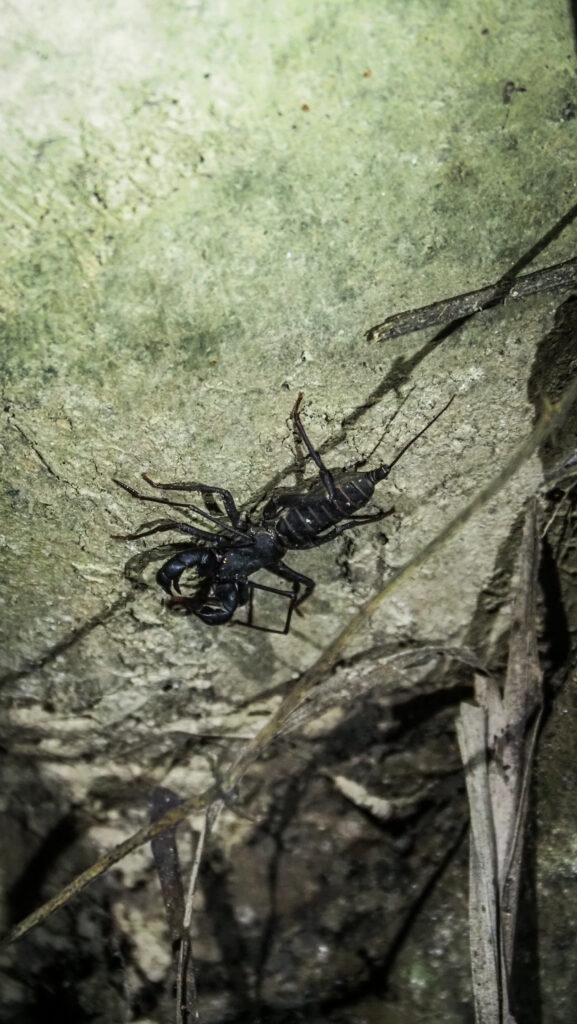
After that, it was a time for jungle walk. It was a really short one but luckily we were able to see one orangutan sitting high on the tree. Another cool thing to see was the spider which blended perfectly well with the color of the tree that it was sitting on.

Kinabatangan River, Borneo
The only orangutan that we saw during the tour
Kinabatangan River, Borneo
What a camouflage!

Once the walk was finished, I flew a drone and discovered a very sad view. The area around the river is one huge palm oil plantation. I wasn’t surprised that we couldn’t see that much wildlife and that we always went on river safari to the same place. It was just the only relatively forested place left.

Kinabatangan River, Borneo
Flying over the Kinabatangan River

After lunch, we had a few hours of free time but we were also offered to join an extra activity: a fishing trip (paid extra: 60 RM per person). I decided to go for it as I don’t like sitting in one place doing nothing and I didn’t have much experience with fishing so wanted to learn something new. Unfortunately, we were caught by some rain but that is how it is in Borneo. You never know when you will get wet 🙂

I managed to catch 4 or 5 small catfish, but my fishing rod got stuck many times in shallow waters. Anyway, I was happy to join this activity and would recommend you to do the same. I will for sure repeat fishing one day!

In the afternoon we went to the third river safari and again it was to the same place. We mostly saw different kinds of monkeys and once it was already after sunset, then plenty of huge bats (flying foxes) could be spotted in the sky. Impressive and very memorable view!

Kinabatangan River, Borneo
Proboscis monkey
Kinabatangan River, Borneo
Proboscis monkey

After dinner, we went for a night walk and saw some spiders, frogs and bugs. The guide was trying hard which was appreciated but unfortunately, we couldn’t find slow loris or tarsier.

Day three

We had breakfast and then it was time to pack our bags and board the boat back to the jetty. There, we split into two vans – one going back to Sandakan and another one heading towards Lahad Datu. Those heading to Lahad Datu, including me, had to pay extra for the transport (50 RM per person).

2 days 1 night itinerary

You will do a night boat ride on the day you arrive at the camp and a morning boat ride the next day. After breakfast, you will leave the camp at about 10 AM.

General impressions

I’m glad I decided to join the tour with Uncle Tan and I cannot say a bad word about the organization as everything went according to plan and the staff working at the camp were very friendly. However, I wouldn’t repeat it.

The reason is very simple. I was quite shocked to see the destruction of the area and deforestation in favour of palm oil plantations. Don’t expect to see some wonderful wild areas full of animals. There is a thin line of trees along the river but you can see through it. And everything beyond is nothing more than palm oil plantations. Some years ago it must have been a wonderful place, now it’s just the skeleton left…

Powered by GetYourGuide

Sepilok, located in the Malaysian state of Sabah on the island of Borneo, is renowned primarily for the Orangutan Rehabilitation Centre and hiking opportunities at the Rainforest Discovery Centre.

How to get to Sepilok?

Getting to Sepilok typically involves travelling to Sandakan, a city in the Malaysian state of Sabah on the island of Borneo.

By Air

Several airlines operate flights to Sandakan, including Malaysia Airlines and AirAsia, with direct flights available from Kota Kinabalu (the capital of Sabah) and Kuala Lumpur (the capital of Malaysia). To get from Sandakan Airport to Sepilok the best way is to use the ride-hailing service, Grab.

By Land

There are bus services from Kota Kinabalu to Sandakan passing through Kundasang and Sepilok. The journey takes about 6-8 hours. Ask the driver to drop you off at Sepilok.

Alternatively, you can also rent a scooter in Sandakan and just ride to Sepilok for a day trip which is exactly what I did.

For ticket booking, visit Easybook or 12Go.Asia

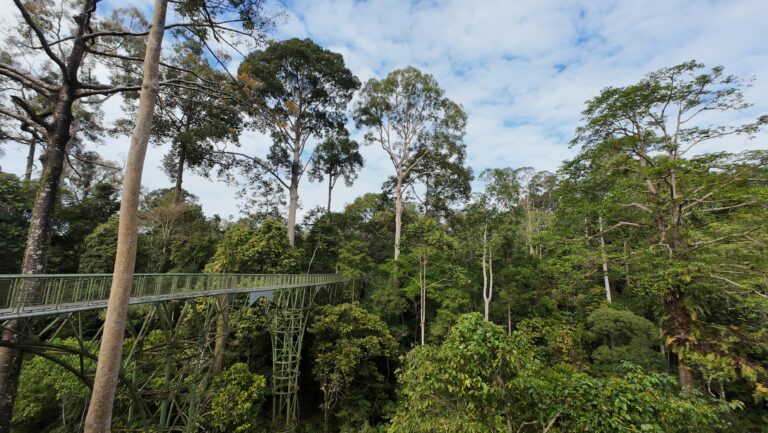
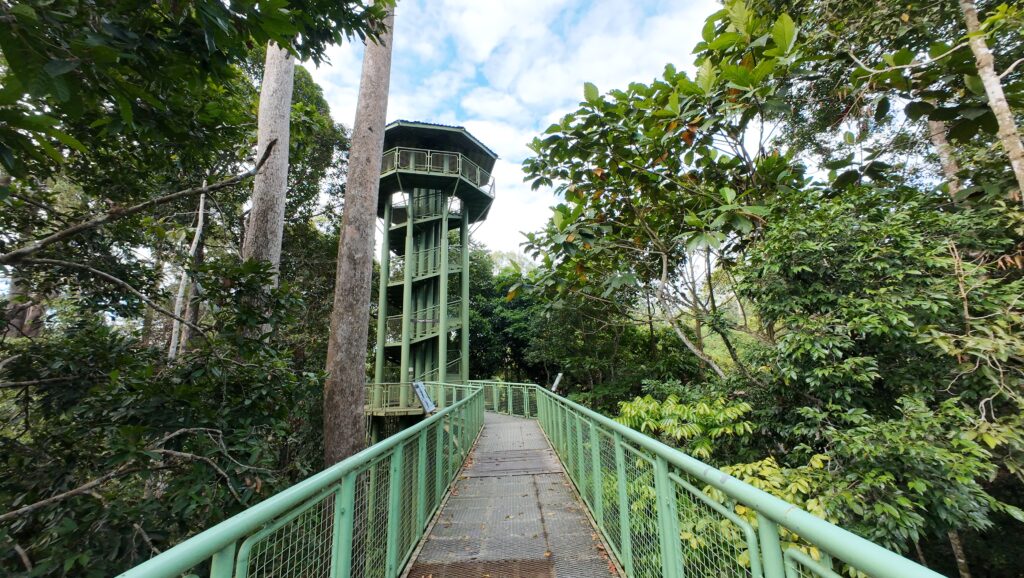
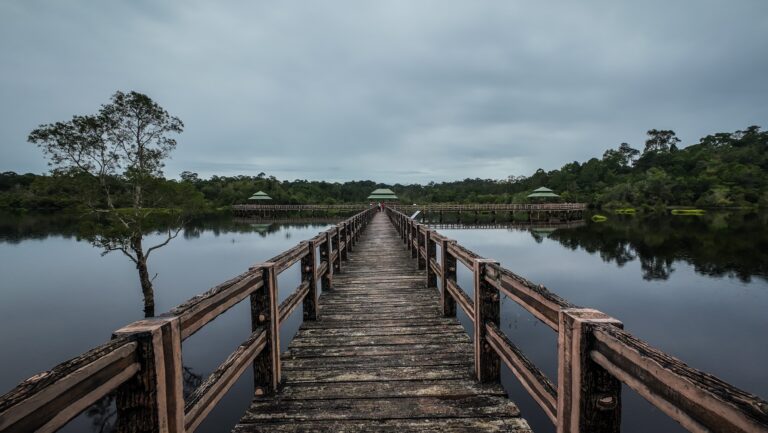
Walkway in Rainforest Discovery Centre

When to go?

The best time to visit Sepilok is during the dry season, which typically falls between March and October. The weather during these months is generally more favourable with less rainfall, making it easier to explore the rainforest (the trails are less muddy) and enjoy outdoor activities.

How long to stay?

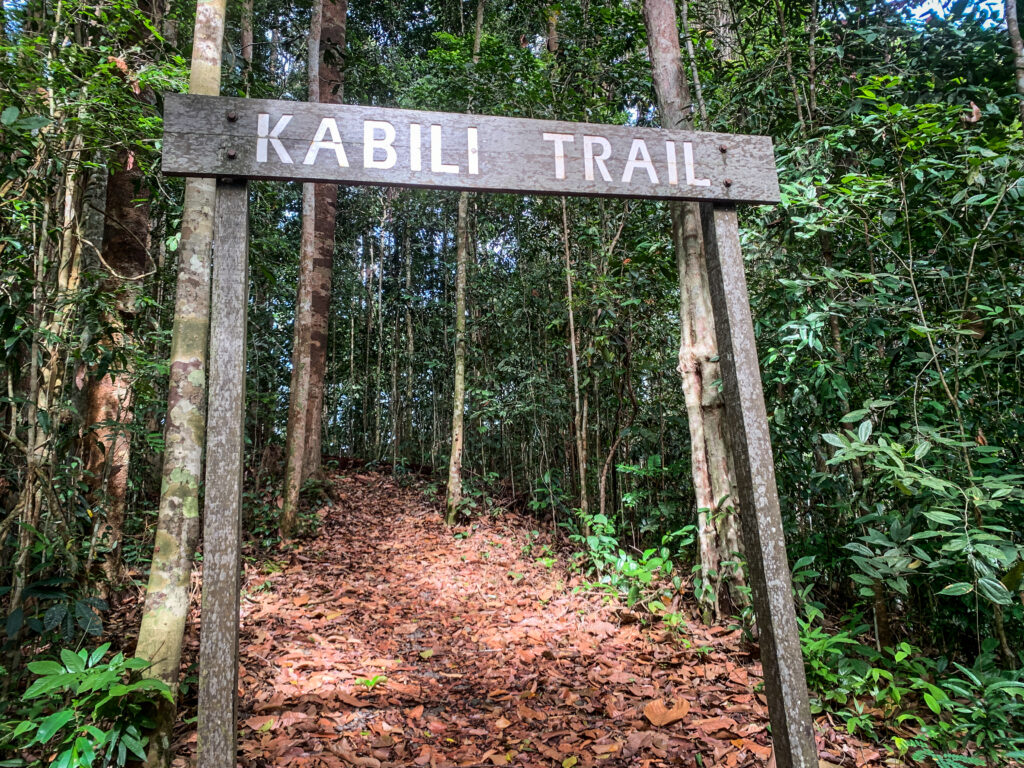
It depends if you are planning to hike the Kabili Trail within the Rainforest Discovery Centre. If yes, it will take you a minimum of 5-6 hours and you won’t be able to fit much more into your daily schedule. Therefore, I would plan 2 days in the Sepilok area to comfortably visit the rest of the sights on the second day.

If you don’t plan to hike the Kabili Trail, then one full day is perfectly enough.

How to get around?

Three major sites are located very close to each other, within walking distance: Bornean Sun Bear Conservation Centre, Sepilok Orang Utan Sanctuary and Rainforest Discovery Centre.

To get to Labuk Bay Proboscis Monkey Sanctuary you will need a taxi or a rented scooter. Inquire at your accommodation or check on the mobile app – Grab.

What to do in Sepilok?

Bornean Sun Bear Conservation Centre

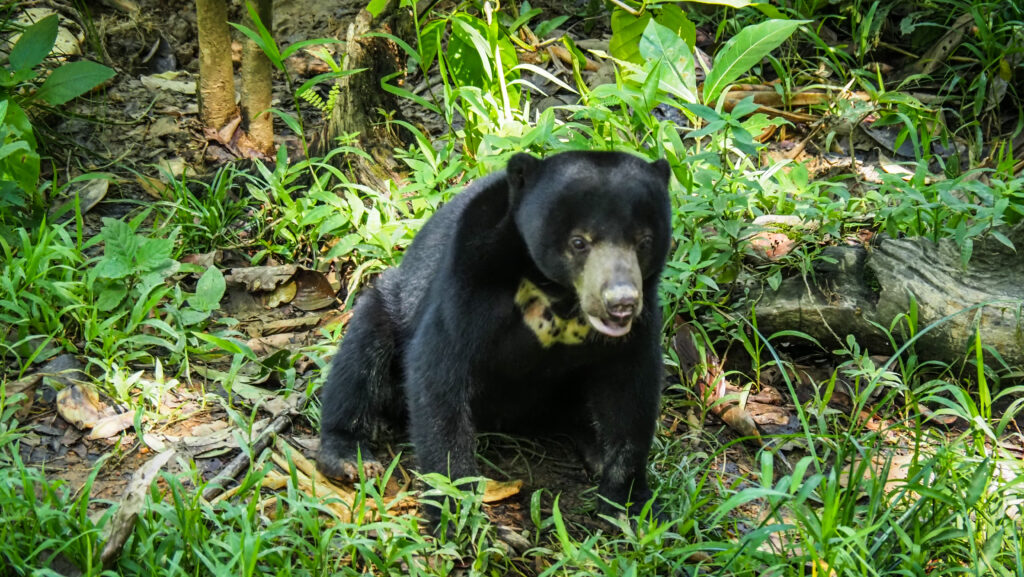
The sun bear, the smallest bear species worldwide, gets its name from the golden band of fur that encircles their necks. Sun bears can be found in Borneo, eastern India, southern China, Myanmar, Laos, and Vietnam, among other parts of Southeast Asia. With their large claws, they can easily climb tall trees in pursuit of beehives. Additionally, they manage the damaging termite population in the forest, which is an essential component of the bears’ diet.

They are the second most endangered bear species in the world and the centre takes good care of them. Before being released into the wild, a new newcomer will learn how to forage, make nests, climb, and interact with others. The gift shop plays a film that educates customers about the important work of the centre.

The entrance ticket costs 50 RMB for non-Malaysians and 10 RMB for Malaysian adults.

Sepilok, Sabah, Borneo
Bornean Sun Bear Conservation Centre

Sepilok Orangutan Sanctuary

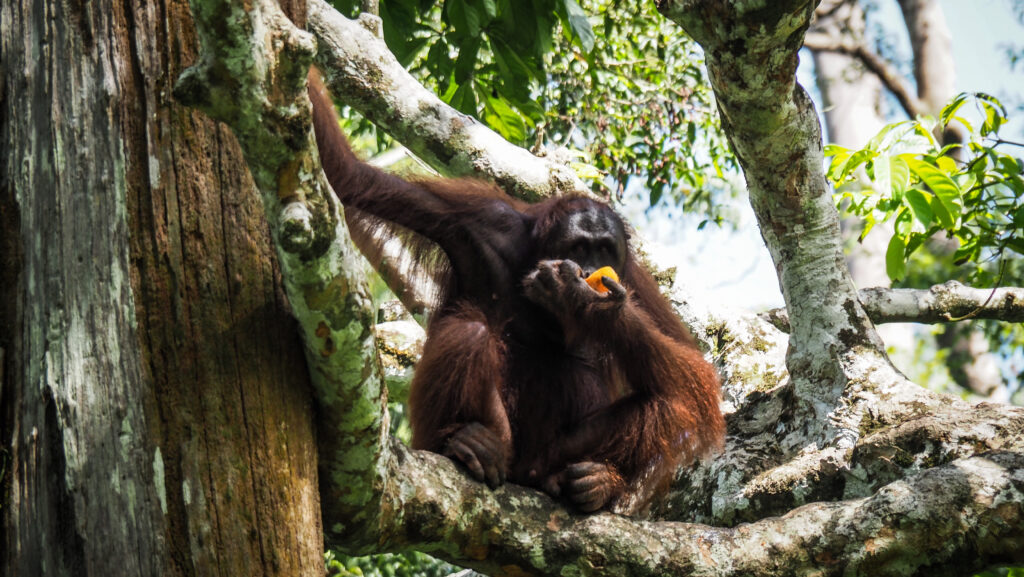
The Sepilok Orangutan Rehabilitation Centre was established in 1964 by Barbara Harrison, an Englishwoman, who worked in collaboration with the government of Sabah. The centre was founded to rehabilitate orphaned and injured orangutans so they could eventually return to the wild.

Initially, the centre focused on rescuing young orangutans who were displaced due to logging, deforestation, and illegal pet trade. The early years involved significant efforts in raising awareness and educating the public about the plight of orangutans. Over the years, the rehabilitation process at Sepilok has evolved. Young orangutans are taught essential survival skills, including climbing and foraging, in a safe and controlled environment before they are gradually released into the forest.

Feedings at the platforms are at 10 AM and 3 PM, and last 30 to 50 minutes. Tickets are valid for one day, so you can see two feedings with the same ticket. I visited in the morning and the place was extremely crowded with people which took away most of the charm of this place. I felt like I was in some kind of a zoo…

Sepilok, Sabah, Borneo
Sepilok Orangutan Sanctuary

Rainforest Discovery Centre

In addition to eight canopy towers connected by walkways that offer you a bird’s-eye view of the treetops, there are many gentle walking routes. Get a map at the ticket office. Join a night walk for increased chances of spotting tarsiers, slow loris, civets, flying squirrels, and other nocturnal creatures.

Regarding the trails, a Forest Reserve Entry Permit is needed for the 16-kilometre round-trip Kabili Trail. You can easily get it at the ticket office for 35 RMB. The main difficulty of the trail is weather humidity and high temperature, so take plenty of water on you and some clothes for change. In May there weren’t any leeches. Along the path, there are three shelters where you can take a rest. The trail is well marked and in my opinion, there is no need for a guide but they can be hired if needed.

The Sepilok Laut Reception Centre at the end of the trail is reached by walking for 1 km on a boardwalk through the mangrove. You can even spend a night there but need to plan it up front and bring enough water and food. Alternatively, it is possible to arrange a boat pick-up from the centre to Sandakan, but you have to do it a couple of days in advance. Otherwise, you just have to do the trail as an out-and-back day trip. 

Sepilok, Borneo
Entrance to the Kabili Trail

Labuk Bay Proboscis Monkey Sanctuary

The Labuk Bay Proboscis Monkey Sanctuary is situated inside an oil palm field. The 400-acre property was set to be cleared for the development of oil palm in the mid-1990s when the owner learned that proboscis monkeys were residing in the mangrove forest. He chose to keep this little area of woodland intact as a monkey refuge.

Labuk Bay’s environment is fragmented, with small areas of mangrove forest encircled by plantations. The monkeys are fed extra food because there isn’t enough of it. Somehow I had the feeling that the story of this place fits very well with the general story of Borneo and the fact that wild animals are pushed out of their natural habitats and can only survive on those small, controlled sections… just as a tourist attraction to generate money. That’s why after visiting Sepilok Orangutan Sanctuary and Bornean Sun Bear Conservation Centre, I felt quite depressed and decided not to come here. I hoped to see proboscis monkeys truly wild, but maybe I was too naive.

This privately run sanctuary has two observation platforms. Feeding takes place at Platform A at 9.30 AM and 2.30 PM and at Platform B at 11.30 AM and 4.30 PM. At most feeding times groups of proboscis monkeys descend from the nearby forest and mangroves and head to the wooden platform for a free meal.

Powered by GetYourGuide

Nestled on the lush northern coast of Borneo, Brunei Darussalam is an interesting place often overshadowed by its larger Southeast Asian neighbours. This small nation offers a unique blend of opulent history, rich cultural heritage, and pristine natural beauty. Governed by one of the world’s last remaining absolute monarchies, Brunei stands out with its harmonious blend of traditional Malay customs and Islamic principles, seamlessly woven into the fabric of modern life. From the grandeur of the Sultan Omar Ali Saifuddien Mosque to the serene waters of Kampong Ayer, and the untouched wilderness of Ulu Temburong National Park, Brunei promises an adventurous journey!

A brief history

The area now known as Bandar Seri Begawan was historically a centre of power for the Bruneian Empire, which reached its peak in the 15th and 16th centuries. It was a vital trading hub in Southeast Asia, engaging in commerce with China, the Malay Peninsula, and other regions. Brunei was well known for its rich sources of exotic jungle and sea products like camphor, spices, agarwood, lakawood, resins, sago, birds’ next, wax, honey, tortoise and turtle shell as well as its pearls.

Early settlements in the area were part of Kampong Ayer, a historic water village along the Brunei River. This area has been inhabited for over a thousand years.

The reign of Sultan Bolkiah (1485 – 1524) was known as the golden age of Brunei. During his reign, the sultanate not only covered the entire Borneo Island but even reached as far as Luzon in the Philippines. Its importance further grew when Malacca fell into the hands of the Portuguese in 1511.

Bandar Seri Begawan, Brunei
Omar Ali Saifuddien Mosque at night

In the late 19th century, Brunei became a British protectorate. During this period, the capital, then known as Brunei Town, saw infrastructural developments, although it remained relatively small and traditional.

The town was occupied by Japanese forces from 1941 to 1945. During this time, much of the town was destroyed by Allied bombing, necessitating significant post-war reconstruction.

After World War II, Brunei Town underwent substantial rebuilding and modernization. In 1970, it was officially renamed Bandar Seri Begawan in honour of Sultan Omar Ali Saifuddien III, who abdicated in 1967 but was instrumental in the country’s modernization efforts.

The discovery of oil and natural gas significantly boosted Brunei’s economy in the mid-20th century, leading to rapid urban development. The city developed modern infrastructure, including roads, buildings, and public amenities. Despite modernization, Bandar Seri Begawan has maintained its cultural heritage, particularly in Kampong Ayer, where traditional stilt houses are preserved.

How to get to Brunei?

To get to Brunei, you can consider the following options:

By Air

The fastest and most convenient way to reach Brunei is by flying. Needless to say, it’s also the most expensive option, even if you take a short flight from Kota Kinabalu.

By Land

Travelling by land is possible if you’re coming from neighbouring Malaysia. There are bus services from Miri or Limbang in Sarawak and Kota Kinabalu in Sabah. This journey from Kota Kinabalu can be even 10 hours long and involves crossing the border 4 times so get your passport ready for plenty of new stamps.

Bandar Seri Begawan, Brunei
One of a few city mosques

By Sea

Ferries operate between Labuan, a Malaysian island, and Muara, Brunei’s main port. The ferry ride takes about 1.5 to 2 hours. Check the schedule beforehand as the connections aren’t daily.

For ticket booking, visit Easybook or 12Go.Asia

When to go?

The best time to visit Brunei is during the dry season, typically from January to May. During these months, the weather is generally warm and less humid, with lower rain chances, making it ideal for outdoor activities and sightseeing. In other months you can expect higher humidity and more rain but still, you will have no problems with getting around.

Brunei Darussalam
Kampong Ayer

Where to stay?

I stayed 3 nights in a private single room at Co. Living Hostel Bandar. The bathroom was shared and clean but unfortunately only one for the whole hostel. The internet was really fast and there was a small desk in the room, making it perfect for online work. The location is within walking distance of the waterfront and Omar Ali Saifuddien Mosque.

For the last 2 nights, I moved to EZ Lodgings. There were 2 shared bathrooms and the room was quite spacious. The location is near The Gadong Mall and the main tourist attractions are within 10 minutes taxi ride.

You will find much more options on Agoda than on Booking.com

How to get around?

To visit attractions located outside of Bandar Seri Begawan, you will need a rental car. I got my Toyota Vios from D.Feena for 55 BND per day + 100 BND refundable deposit. You can contact them at defeenamarketing@gmail.com or +673 877 8898 (also on Whatsapp).

What to see outside of Bandar Seri Begawan?

Ulu Temburong National Park

Established in 1991, the park spans approximately 50,000 hectares and is accessible primarily by boat, which adds to its remote and untouched allure. To get there, you need to sign up for an organized tour, something that I don’t like doing too often unless there is no other way.

Having checked different options, I selected the tour offered by Freme. They seem to have the most experience and from the price perspective, it’s the same for all operators. Unfortunately, it isn’t cheap as a day tour costs 155 BND.

I was picked up at 7:45 AM from the Gadong area and then we made a few more stops to pick up more tourists. Once everyone was on board, we left Bandar Seri Begawan and crossed Sultan Haji Omar ‘Ali Saifuddien Bridge to Temburong District.

After arrival at Freme Rainforest Lodge, we got morning tea and some snacks and soon safety briefing followed. We got life jackets and jumped on the longboat to be transported upstream to the start of the hike up to Canopy Tower.

The boat ride was nice indeed, but nothing too spectacular. Not if you have visited some other national parks in Southeast Asia before, for example, Taman Negara.

The Canopy Walkway was a bit different from other similar constructions that I have experienced in Malaysia. That one was very stable as it was all made from metal. We had to climb up on a ladder, then walk on a short bridge towards the highest point and then descend. Nice experience but again nothing super thrilling.

Brunei, Asia
Ulu Temburong National Park

From there we went to the boat again and stopped at the waterfall. Disappointing place with little water and a small pool including a so-called “fish spa”. Once you put your feet in the water, small fish come over to nibble away your dead skin. Can be tickly! It must be an attraction if you do it for the first time, but I have already experienced it in Thailand, Sri Lanka and many other places in the region.

Then we came back to the boat again and soon were dropped out at the riverbank for the last activity. Backpacks and our shoes stayed in the boat as we jumped inside the rubber tubes and went with the river flow back to the lodge. It was probably the best part of that trip but again somewhat disappointing as it felt too short.

Some people did zip lining but for those who did tubing, it was not included in the package. Such a pity. The lunch was fine, a regular Asian buffet.

After lunch, the bus took us back to Bandar Seri Begawan and we arrived about 4 PM. Quite early for the whole day trip! Overall, everything was well organized but I had the feeling that there is a potential for more or it should be just around 50% cheaper for what it was. Not something that I would like to repeat.

Brunei, Asia
Ulu Temburong National Park

Bukit Patoi Recreational Park

The best hiking route in the Temburong area. You can make it a loop, which is about 4 kilometres long. Going up can be challenging especially in high humidity, to take lots of water! The track can be slippery, especially after rain. Frequent panels show the distance remaining to the peak.

Brunei, Asia
Bukit Patoi Recreational Park

Sultan Haji Omar ‘Ali Saifuddien Bridge

This dual-carriageway bridge in Brunei links the country’s semi-exclave of Temburong with the mainland by spanning Brunei Bay. At thirty kilometres, it is the longest bridge in Southeast Asia.

The bridge’s construction began in 2014, and although it was initially scheduled to be finished and opened by the end of 2019, it opened in March 2020 instead.

The bridge was renamed the Sultan Haji Omar ‘Ali Saifuddien Bridge on July 14, 2020, the day of Sultan Haji Hassanal Bolkiah’s 74th birthday. The reason was to honour the late Sultan’s father, Sultan Haji Omar ‘Ali Saifuddien Saadul Khairi Waddien, who is largely recognized as the architect of modern Brunei.

Brunei, Asia
Sultan Haji Omar ‘Ali Saifuddien Bridge

Muara Beach and Meragang Beach

The popular weekend getaway at Muara Beach Recreational Park is well-liked by locals. It is a nice beach, but like many beaches in Borneo, it is covered in driftwood and other floating debris from the sea. Picnic tables are available.

Meragang Beach is located further to the west. There is a parking and some street vendors near where the Meragang River flows into the South China Sea. The sandflies can be a problem, so spray yourself with insect repellent before going to the beach.

Brunei, Asia
Muara Beach

Taman Warisan Tasek Merimbun

The largest lake in Brunei, which is home to a diverse range of birds. Nice place but seems to be quite run down. There is a short concrete walkway along its bank.

Brunei, Asia
Taman Warisan Tasek Merimbun

Lalak Lake National Park

The area around the lake is a relaxing place good for bird watching and walking on a boardwalk. It’s quiet in the morning but you can see local people fishing in the afternoon.

Wasai Wong Kadir Recreational Park

It takes around 20 minutes to get to the waterfalls. Nothing too impressive in terms of size but the pool is big enough for a swim. The place can get busy at weekends.

Teraja Longhouse

The long house is mainly visited by those heading to two nearby waterfalls: Wasai Teraja and Wasai Belulok. You will pay a few dollars for parking and a few more to look around the house. There are lots of historical photos and small locally-made crafts to purchase.

Wasai Teraja (waterfall)

The trail starts just behind the longhouse and it’s a nice short jungle trek. You will need to cross the river a few times before reaching the waterfall. The whole journey is about 45 minutes one way.

Wasai Belulok (waterfall)

Challenging trek and the path is sometimes hard to find. However, after reaching there, most probably you will have the waterfall all to yourself. The journey takes around 40 minutes one way. Be careful not to get lost!

Billionth Barrel Monument

The monument was built in 1991 and commemorates the billionth barrel of oil produced in the onshore oil field in Seria.

Brunei, Asia
Billionth Barrel Monument

Seria Energy Lab

An interactive exhibition about the oil & gas industry managed by Brunei Shell Petroleum. They have lots of activities for children. Unfortunately, as of May 2024, it is closed for renovation without any clear information on when it is going to reopen.

Masjid Kampong Pandan

The mosque was opened in 1996 and can hold up to 1,100 individuals in single assemblage.

Brunei, Asia
Masjid Kampong Pandan

Pantai Ku Ceria (KB Beach)

Another mediocre beach in Brunei, however, if you are looking for one, it’s still better than many others.

Powered by GetYourGuide